
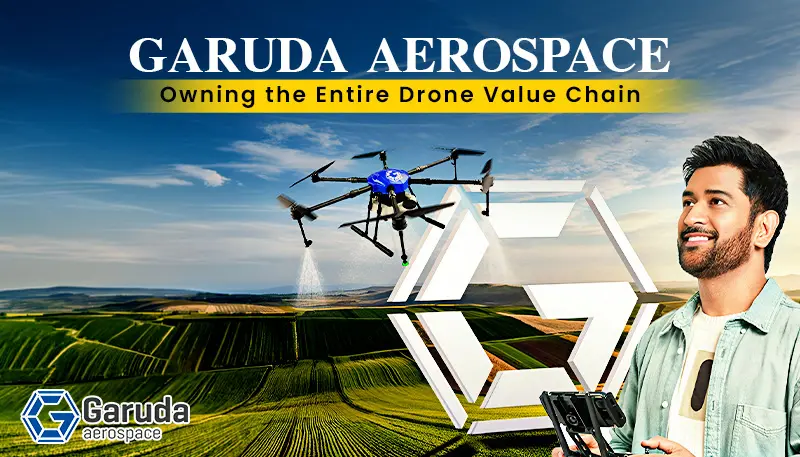
Garuda Aerospace: Owning the Entire Drone Value Chain
Apr 7, 2026
Look at any serious India’s drone industry today, and one name keeps showing up again and again across almost every important part of the value chain. Garuda Aerospace IPO is something investors are closely watching, as the company continues to expand rapidly across multiple segments of the drone ecosystem. From manufacturing and software to data analytics, Drone-as-a-Service, agricultural use cases, industrial applications, and even defence-adjacent operations, Garuda has quietly built a presence that most traditional industrial companies take decades to achieve.
What makes this company’s value chain presence more interesting is how this journey began.
Garuda Aerospace, the company founded in 2015 founded by founder Agnishwar Jayaprakash based in Chennai. Back then, most startups were focused on software and digital products, but the founder was very keen to do something different and remain dedicated to work and chose a completely different path, something not very flashy, but actually useful. His idea was straightforward: build drones that could help farmers by spraying pesticides, solving a real problem that people had been dealing with for years but no one had really fixed.
That single use case gave Garuda what matters most in any hardware business: real operational experience before the market got crowded.
While the rest of India's drone industry was figuring out which single segment to chase manufacturing, services, software, agriculture Garuda was quietly building presence across all of them.
It Started With a Farmer's Back
Before the government schemes, before the investor interest, before "Made in India drones" became a national conversation. A farmer. The starting point wasn’t a boardroom idea—it was far more real. A 40-degree afternoon, walking through fields with a pesticide tank strapped to his back. That experience shaped the problem he wanted to solve.
Agnishwar Jayaprakash saw that problem in 2015 and didn't pitch a deck about it. He built a drone for it.
That decision to start unglamorous, to start where the pain was real and daily gave Garuda something no funding round can manufacture: genuine operational depth. Thousands of real flight hours. Real crop data. Real Indian terrain, real Indian weather, real failure modes discovered and fixed the hard way.
By the time competitors arrived with better pitch decks and larger cheques, Garuda had already earned its PhD in Indian skies.
Today the company sits across multiple segments of India's drone value chain simultaneously: manufacturing, software, Drone-as-a-Service, agriculture, industrial, and defence applications. Each segment feeds the next. Build your own drone, keep service costs low. Run the service, collect proprietary data. Use that data, build better software. Better software means customers don't leave.
That's how presence gets built.
The PLI Moment
The major transition came in September 2021, when the Indian government of India introduced the initiative of Production Linked Incentive (PLI) scheme for drones. This was introduced with the funding of setup an outlay of ₹120 crore, the aim was clear to reduce dependence on imported drone components and build a strong, homegrown industry that could eventually compete on a global scale.
The timing was revealing. Many companies that today present themselves as serious drone manufacturers essentially came into existence around the PLI announcement, structured specifically to qualify for the incentives. Garuda was already operating, already generating revenue, already accumulating the operational experience that the scheme was ostensibly designed to reward.
This distinction matters enormously in how you assess the company's foundation. PLI incentives are meaningful and valuable but they're a tailwind, not a foundation. Companies that exist before the wind arrives tend to compound its benefits far more effectively than those built to catch it.
Garuda's PLI certification came as validation of an existing business, not as the creation of one. That's a meaningful difference.
Why Multi-Segment Presence Makes Strategic Sense
The natural skeptic's question about Garuda's presence across so many value chain segments is whether it represents strategic coherence or simply opportunistic expansion dressed up as strategy. It's a fair question, and the honest answer is: the flywheel logic is sound, even if execution complexity is real.
Here's how the segments connect:
Manufacturing feeds Services. A company that designs and builds its own drone hardware has structurally lower costs when deploying those same drones as a service compared to a pure-play DaaS operator buying hardware from third parties. Every rupee of manufacturing efficiency flows directly into margin on the service side.
Services feed Data. Every hour of drone operation generates proprietary data on crop health, terrain mapping, infrastructure inspection, logistics routes. That data, aggregated across thousands of deployments, becomes a genuine analytical asset. The drone is increasingly just the vehicle. The data is the product.
Data feeds Software. Garuda's positioning in software and analytics isn't an unrelated diversification. It's the logical next layer on top of operational experience that competitors simply don't have. A software product built on ten years of Indian agricultural drone data is qualitatively different from one built in a lab.
Software creates stickiness. Once a customer, whether a state agriculture department, an industrial inspection client, or a defence contractor is integrated into your operational software and analytics platform, switching costs rise dramatically. The relationship deepens beyond a transactional hardware or service sale into something closer to infrastructure dependency.
This is the flywheel Garuda has been assembling, segment by segment, sometimes messily, sometimes ahead of the market's readiness to receive it but assembling it nonetheless. When it comes to the Garuda Aerospace share price, there is increasing curiosity in the unlisted market, especially given the company’s strong positioning and government support.
About the Defence Dimension
One of the more interesting aspects of Garuda's value chain positioning is its presence in defence-adjacent applications, a segment where it sits alongside genuine Indian industrial heavyweights. HAL, Tata Advanced Systems, Adani Defence and Aerospace, Larsen & Toubro these are companies with defence revenues that dwarf Garuda's entire valuation.
But Garuda isn't competing with them on their terms. It isn't bidding for fighter jet avionics contracts or naval surveillance system tenders. What it brings to the defence conversation is something the large primes find genuinely difficult to offer: operational agility, software-first architecture, and the ability to deploy, iterate, and extract intelligence from drone systems at the pace that modern tactical requirements demand.
The global military conflicts of the past three years have radically changed the way defense organizations think about drone requirements. The lesson absorbed, painfully and clearly, is that small, commercially-derived, software-sophisticated widely deployed drones can have a tactical impact that expensive slow-to-buy conventional systems cannot replicate. India's own defence establishment has been paying close attention.
This creates a genuine opening for companies like Garuda not to displace the large primes, but to operate in the agility gap that their organisational structures make it nearly impossible for them to fill.
What the Value Chain Dominance Actually Means
Step back from the individual segment analysis and the picture that emerges is this: Garuda Aerospace has spent nearly a decade building something that is genuinely difficult to replicate quickly: operational drone expertise at Indian scale, across Indian conditions, serving Indian customers.
This expertise lies in institutional knowledge accumulated from flight data farmer-government relationships, a team that has seen drones fail in monsoon conditions and discovered why in software calibrated to Indian terrain and use cases. Like None of these are clearly visible on the balance sheet and cannot be bought or replicated in any funding round no matter how large.
The companies that have tried to enter India's drone market well-capitalised but operationally thin have, with some exceptions, found the market harder than the infographics suggested. The operational complexity of India, its terrain diversity, its regulatory patchwork, its customer education requirements, its supply chain constraints -- turns out to be meaningful protection for those who've learned to navigate it.
The company is planning to raise around ₹1,000 crore through its IPO, which will include a fresh issue of approximately ₹750 crore along with an offer for sale (OFS) worth ₹250 crore. Based on current developments and market timelines, the listing is expected to take place around late 2026, although this will depend on regulatory approvals and market conditions at the time.
Currently, Garuda Aerospace unlisted shares are gaining traction among early investors. At present Garuda Aerospace Unlisted Shares are trading at ₹543 per share, reflecting growing interest in the company’s future potential.
The Road Ahead
Garuda's strategic position is arguably stronger today than before in its history and stands in a position where Government policy is clearly supportive. Policy support is clearly in its favor, and the ecosystem around it is finally catching up with the vision it started with. Defence demand is structurally growing. Agricultural drone adoption is scaling. Industrial inspection and logistics use cases are finding commercial traction.
But the next chapter of the Garuda story will be determined by execution factors that are harder to assess from outside the organisation. Can leadership manage the organisational complexity of operating across six distinct business segments without losing the operational focus that built the company's foundational strengths? Can they build the enterprise software capability that their analytics ambitions really demand or will it remain more of an ambition than a product? Are they able to navigate away from revenue burdened by government contracts to more commercially diversified recurring revenue streams that are more attractive to institutional investors?
India's drone industry is still in early innings. The value chain is forming, the demand is real, and the policy environment is as supportive as it has ever been. In that context, the company that owns the most segments of the architecture and has the operational depth to back up that presence starts the next phase of the game with a structural advantage that pure capital cannot easily erase.
Stay Connected, Stay Informed –
Don’t miss out on exclusive updates, market trends, and real-time investment opportunities. Be the first to know about the latest unlisted stocks, IPO announcements, and curated Fact Sheets, delivered straight to your WhatsApp.