


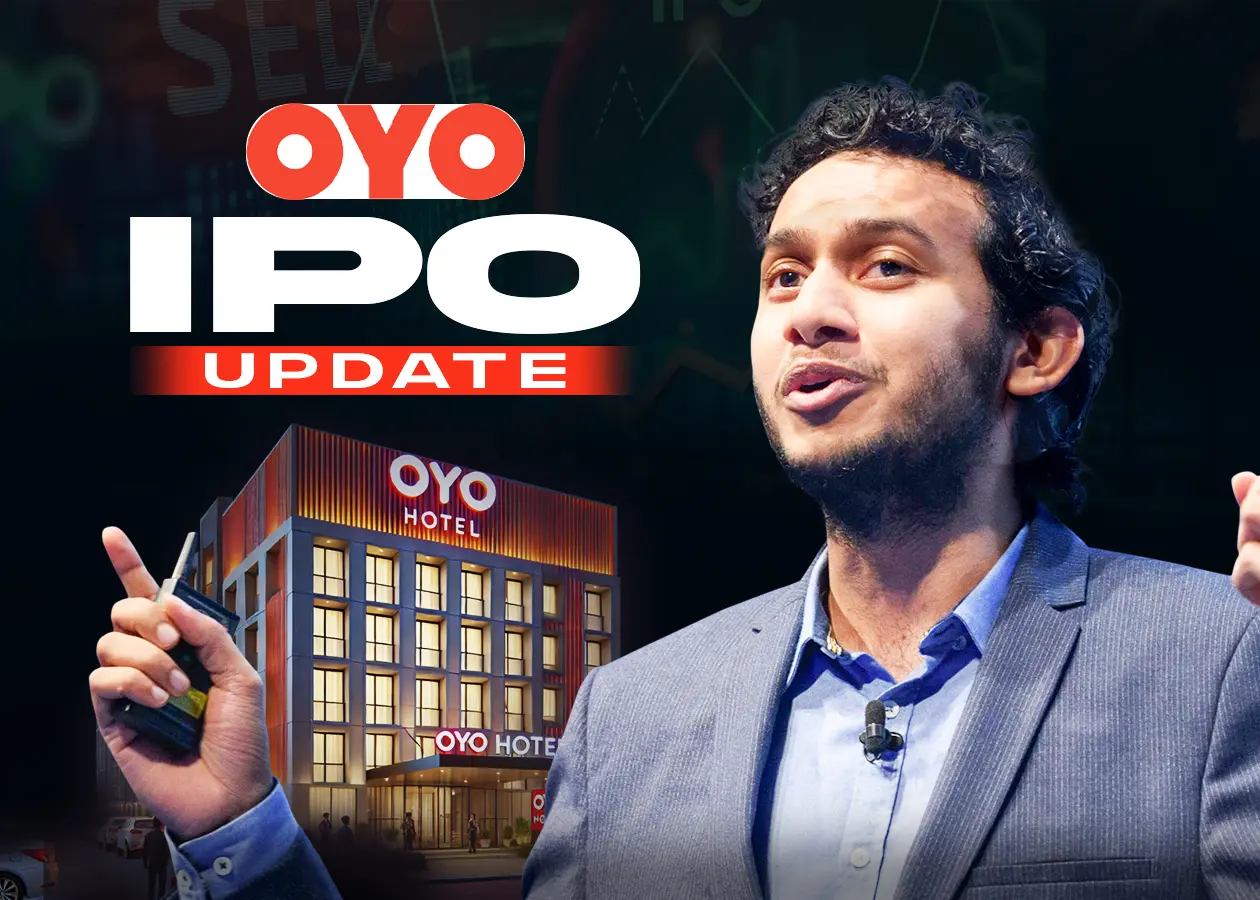
OYO IPO Update: Final SEBI Nod Expected This Week, Issue Size Cut To ₹6,500 Crore
Written by: Diksha Kalra
Published: May 15, 2026
Updated: Sep 10, 2026
13 min read
There is something almost poetic about the fact that OYO's IPO story began in the middle of a pandemic and is now, four years later, finally approaching its conclusion. PRISM, the holding company behind OYO officially registered as Oravel Stays Limited, is widely expected to hear back from SEBI with its final observation letter sometime this week. For a company that has gone through the filing process more times than most startups even attempt, this is genuinely a big deal.
The final observation letter from SEBI is not a minor procedural formality. It is essentially SEBI's way of saying it has gone through everything, is comfortable with what's been disclosed, and doesn't have any more questions. Once PRISM gets that letter, the road ahead becomes much clearer; they can release the updated draft prospectus to the public, announce a price band, and lock in a listing date. The long-awaited OYO IPO will have officially entered its final stretch.
From ₹8,430 Crore to ₹6,500 Crore, A deliberate Step Down
The fundraising amount OYO is looking to raise has already got people talking. When the company first knocked on SEBI's door in 2021, it had its eyes set on ₹8,430 crore. But that was a completely different era. Indian markets were on a high, unprofitable startups were somehow commanding billion-dollar valuations, and ordinary retail investors were falling over each other to get into every flashy new listing. Then the mood shifted. Global markets got nervous, geopolitical trouble started brewing, and OYO quietly pulled its filing without much fanfare.
This time, the company is looking to raise ₹6,500 crore noticeably less than before, and even a touch below the ₹6,650 crore that shareholders had already signed off on. That ₹150 crore difference might seem like a rounding error, but it's actually a deliberate signal. The banks running this deal ICICI Securities, Axis Capital, Goldman Sachs, and Citibank, along with a few others added to the syndicate are choosing to be conservative rather than ambitious. These are experienced people who understand where market appetite actually sits right now, not where a company's wishlist begins. They are raising what they believe investors will comfortably put in, and leaving the ambition for another day.
This is the kind of discipline that was largely absent in 2021. And it is exactly what gives this IPO attempt a more credible foundation than its predecessors.
OYO IPO Structure
There is no Offer for Sale in this IPO. Every rupee of the ₹6,500 crore raised will flow directly into PRISM's balance sheet. That is a structurally important detail. It means no existing investor is using this IPO as an exit; the capital genuinely goes to work for the company.
The deployment plan has three broad priorities. The first and largest is debt repayment. PRISM has carried significant borrowings for years in FY25 alone, the company's finance costs stood at ₹959 crore. Reducing this burden will immediately improve profitability metrics and give the company more financial flexibility going forward.
The second priority is technology and product investment, which has always been central to OYO's pitch to investors that it is a technology-enabled hospitality company, not merely a hotel aggregator.
The third and perhaps most strategically interesting use is the integration of G6 Hospitality, the American budget hotel chain operating under the Motel 6 and Studio 6 brands which PRISM acquired last year for $525 million. This acquisition meaningfully expanded OYO's international footprint and gave it a direct presence in the large and relatively stable US budget travel market. Making that acquisition work efficiently requires capital, and the IPO proceeds will help fund that effort.
The business has been rebuilt
Judging OYO today by what it looked like five or six years ago is neither fair nor accurate. The 2019-2020 version of this company was a different animal altogether spending money faster than it could make sense of, jumping into market after market without a clear plan, and straining relationships with the very hotel partners it depended on. It was the kind of growth that looked impressive in pitch decks and terrible in balance sheets. The headlines from those years were not flattering.
What exists today is a structurally different business. That chapter appears to be over. What's replaced it is a more grounded, discipline-first approach to running the business. OYO stepped away from markets that weren't working, went back to the table with hotel partners to renegotiate terms, trimmed its workforce, and focused on building something more sustainable, a lighter, more efficient model that actually generates margins rather than just chasing revenue numbers.
The results have started to show.In the first quarter of FY26, PRISM posted a profit after tax of over ₹200 crore, compared to ₹87 crore in the same quarter the year before. Revenue from operations grew 47% year-on-year to ₹2,019 crore. Gross Booking Value the total value of all bookings made through OYO's platform jumped 144% year-on-year to ₹7,227 crore, signalling a real and sustained recovery in travel demand across the company's markets.
EBITDA reached ₹550 crore in Q1 FY26, and Moody's which reaffirmed PRISM's B2 corporate family rating with a stable outlook has projected that full-year FY26 EBITDA could exceed $280 million, more than double the previous year. That kind of third-party validation matters when a company is trying to convince public market investors of its financial credibility.
The premium push and global diversification
One aspect of OYO's transformation that does not always get enough attention is the deliberate move upmarket. The company has invested meaningfully in its premium hotel brands SUNDAY Hotels and Palette among them to reduce its historical dependence on the commoditised budget segment. Premium properties generate better margins, attract higher-quality customers, and are less susceptible to the kind of partner churn that plagued the business in earlier years.
One part of the OYO story that rarely gets the attention it deserves is just how global the business has quietly become. India is no longer the engine; more than 80% of the company's total revenue now flows in from international markets. The UK has been a strong performer. Southeast Asia continues to grow. The Middle East adds another layer. Taken together, this geographic spread does something that numbers alone can't always show: it means a bad season in one market doesn't drag the whole company down. That kind of built-in cushion is something most of OYO's domestic-only rivals simply cannot claim.
The recent acquisition of G6 Hospitality takes this logic into the United States, the biggest and most competitive hospitality market in the world. Making that work efficiently will need capital, and a meaningful portion of what OYO raises through this IPO will go toward exactly that.
If PRISM can successfully integrate and scale the Motel 6 and Studio 6 portfolio, it would represent a significant step in OYO's journey from a scrappy Indian startup to a genuinely global hospitality operator.
The OYO Share Price Question
For investors who have been tracking OYO in the unlisted market, the OYO share price has seen considerable movement as the IPO has drawn closer. Unlisted market activity typically reflects a blend of informed speculation, early investor positioning, and general sentiment about a company's prospects. With the listing now targeting the second half of 2026, that unlisted price will soon have a public benchmark to measure itself against.
The proposed valuation range of $7 to $8 billion with a benchmark price of approximately ₹70 per share being discussed puts the company at roughly 25 to 30 times EBITDA. The valuation on the table is not going to win any awards for being modest. Put OYO next to Airbnb, Marriott, or even some of the better-known regional hotel players, and the price tag demands explanation. You cannot just point at the brand name and move on. There has to be a logical reason why this multiple makes sense.
To be fair, OYO does have a few things working in its direction. Growth has picked up in a way that is hard to dismiss. The international business is not decorative, it is actually pulling real weight. And the way technology is woven into how OYO runs its operations is genuinely different from how a conventional hotel group functions.
Whether those factors add up to justify what is being asked is the question every serious investor will be sitting with.But investors will still need to do the math.
What's worth keeping in mind, though, is that even at current levels, this valuation is a long way down from the $12 billion peak OYO was riding in 2021. In that sense, the company comes to market this time with expectations that are far more grounded and perhaps, because of that, far more achievable.
The risks are real and should not be ignored
A balanced look at the OYO IPO requires an honest assessment of what could go wrong. The company's debt load, while being addressed through IPO proceeds, remains substantial. Finance costs consumed nearly ₹959 crore in FY25 and continue to weigh on net profitability even as EBITDA improves.
SoftBank, one of OYO's largest shareholders, has historically been a complicated presence in the company's IPO journey. The Japanese conglomerate reportedly pushed back on earlier listing attempts over valuation concerns. While SoftBank currently remains on the cap table, its post-lockup selling intent will be closely watched by the market once the stock is listed. Large institutional sell-offs in the months following an IPO can suppress a stock's performance regardless of underlying business quality.
The broader macro environment also carries uncertainty. Global travel cycles are variable, geopolitical pressures can affect hospitality flows quickly, and the integration of a large US acquisition adds execution complexity that should not be underestimated.
Early 2026 IPOs have averaged listing gains of just 0.3%. Anyone approaching OYO expecting a Zomato-style first-day pop would be setting themselves up for disappointment. The more relevant lens here is what the business looks like in two to three years, not what the stock does on Day 1.
Why this matters beyond OYO
India's startup ecosystem has been waiting for a signal. The question that has hung over the market since 2022 whether large, once loss-making internet companies can find a genuine and durable investor base in public markets has not been cleanly answered yet.
OYO's IPO will be one of the most important data points in that answer. If it lists well, prices sensibly, and performs credibly in the first year of trading, it opens the door for a generation of late-stage startups that have been sitting on the IPO fence, waiting to see how the market responds.
Founder Ritesh Agarwal has personally invested over ₹1,380 crore into PRISM since 2024, a level of founder commitment that is rare and meaningful. It is the kind of gesture that tells institutional investors something important: the person who built this company believes, with his own money, that the best is still ahead.
Four years, three attempts, and one rebuilt business later the OYO IPO is closer to reality than it has ever been. What happens next will be worth watching.
Stay Connected, Stay Informed –
Don’t miss out on exclusive updates, market trends, and real-time investment opportunities. Be the first to know about the latest unlisted stocks, IPO announcements, and curated Fact Sheets, delivered straight to your WhatsApp.


Planify Enterprises Private Limited
Planify Capital Limited
Licensed By




Mutual Fund License No.:
ARN-164419
IRDA Code (1):
ABLIC1003123454
IRDA Code (2):
ABLIC1003131639
Startup India Certificate No.:
DIPP93786
Other Websites
Address
MiQB, Plot 23, Sector 18, Maruti Industrial Development Area, Opposite VLCC corporate office, Gurugram, Haryana 122015


ⓒ 2016-2026 Planify. All rights reserved, Built with
in India


