
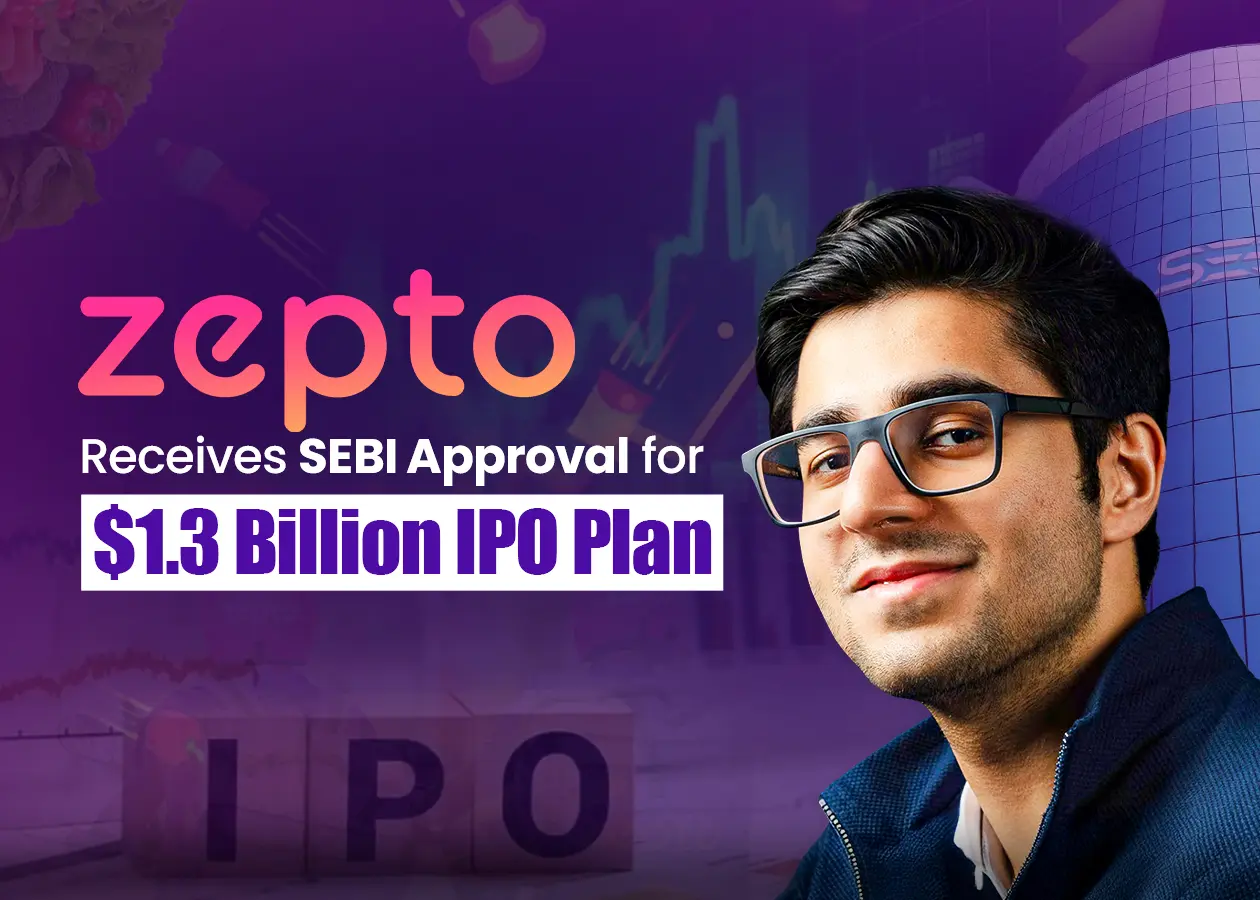
Zepto Receives SEBI Approval for $1.3 Billion IPO Plan
Apr 13, 2026
The regulatory green light is in.
India's quick commerce sector has been building toward a public market reckoning for a while now. This week, it got a step closer. Zepto, the Mumbai-based food delivery startup founded by two Stanford dropouts who were barely 19 when they founded the company has received in-principle approval from SEBI for its ₹11,000 crore ($1.3 billion) IPO. The listing is scheduled to take place between July and September 2026 or the first week of may making Zepto one of the youngest Indian companies to go public just five years after its launch.
For example the approval came through secret registration via the confidential filing route, a mechanism that allows companies to contact the regulatory body and improve their emissions structure without immediately reporting their financials. And yes seriously Swiggy Meesho and Groww Groww took the same path. Zepto filed for a $1.3 billion private equity raise in December 2025 and is now targeting an IPO between July and September 2026.
According to reports the structure of the IPO will include the issuance of new shares and a sales offer to early investors. Zepto has appointed Morgan Stanley Axis Capital HSBC Goldman Sachs JM Financial IIFL Securities, Motilal Oswal as investment bankers for the issue. This is a heavyweight guild. The presence of Goldman Sachs Morgan and Morgan Stanley suggests that Zepto is pitching this as a world-class institutional offering not just a local retail story.
Zepto is expected to issue its prospectus with updated financial statements for the financial year 2026 in the first week of next May once it has finished testing the waters. This is a pre-marketing exercise that allows the company to gauge the appetite of qualified institutional buyers before officially pricing the issue. The schedule in place of the NSE and BSE listing between July and September 2026 is realistic. And did you know that this makes Zepto one of the youngest venture-backed startups in India to go public just five years after its inception.
Zepto Journey to this Point
Aadit Palicha and Kaivalya Vohra started Zepto in 2021, initially as KiranaKart, a kirana-partnership grocery model. The pivot to dark stores changed everything. The company raised money at a pace that reflected how quickly the Indian quick commerce market was being defined. The unicorn's valuation increased from $1.4 billion in August 2023 to $3.6 billion in June 2024, $5 billion in November 2024 and finally $7 billion in October 2025 after a $450 million round. Total capital raised to date is over $2.3 billion.
One structural step that doesn't get enough credit in most IPO coverage: Zepto completed its reverse flip from Singapore to India in January 2025. The company was originally incorporated in Singapore, with the Indian entity as a subsidiary. The NCLT approved Kiranakart Technologies, the Indian entity, to become the holding company of Zepto, a prerequisite for any domestic public listing. CEO Aadit Palicha called it a historic milestone. CFO Ramesh Bafna called it "GharWapasi for the startup ecosystem." The substance behind the symbolism: this involved NCLT and Singapore court approval, a significant tax outlay whose exact amount hasn't been disclosed, and months of legal complexity. Completing it in what both founders called the "fastest-ever timeline" was genuinely an execution achievement.
Zepto Financials: Have a look on numbers
FY25 (year ending March 2025) revenue: ₹11,110 crore, up 149% from FY24 to ₹4,454 crore. On the other hand, net loss reported for FY25: 3,367.3 billion crore that represents a 177% year-over-year increase compared to 1,214.7 crore in FY24.
The math here requires attention. Revenue grew 149%. Losses grew 177%. In FY24, Zepto was spending ₹1.29 to earn every ₹1 in revenue. That ratio has reportedly improved in FY25 with better unit economics, higher fill rates, and stronger contribution margins. But absolute losses still widened dramatically, because the company was simultaneously scaling up from 650 to 1,150+ dark stores and entering dozens of new cities, a spending cycle that shows up in losses before it shows up in revenue.
Here is an important accounting distinction that any investor should understand before reading Zepto's eventual prospectus. Quick commerce platforms typically recognise only 15–20% of gross merchandise value as revenue, accounting mainly for commissions, logistics fees, and advertising income. On this basis, Zepto's estimated operational revenue for FY25 stands between ₹1,495 crore and ₹1,994 crore. The ₹11,110 crore figure reflects inventory-led sales accounting Zepto books the full sale value when it acts as a seller. Blinkit uses a marketplace model and books only its take rate. This difference means the headline revenue numbers are not directly comparable across competitors, even though Zepto's audited figures are valid under Indian accounting standards.
On unit economics the per-order profitability picture that actually tells you whether the business model works Zepto reports meaningful improvement. Average order value (AOV) is approximately ₹550. Gross margin per order is ₹50–70. Fulfilment cost per order is ₹35–45. That means a thin but positive contribution per order before fixed costs like dark store rent, technology, and marketing. According to reports, Zepto was burning ₹660 crore in January 2025 alone, and continued burning ₹450–480 crore a month through March. The company has since claimed to have reduced this burn significantly; management has stated it is targeting EBITDA breakeven within 12–15 months of the IPO, with monthly burn reportedly down by roughly half from its peak.
Zepto has also stated that 75% of its dark stores are already EBITDA positive at the store level, and that new stores now reach breakeven in approximately 8–9 months, down from 23 months when the network was less dense. Management is targeting EBITDA breakeven at the company level within 12–15 months of the IPO.
Balance sheet: Cash and equivalents stood at approximately $600–700 million as of March 2026 materially lower than Blinkit's $1.9 billion and Swiggy's $1.7 billion at the end of 2025. This is the most important financial fact in the entire IPO story. Zepto is not raising ₹11,000 crore because it wants to reward early investors at scale; the IPO is described as predominantly a fresh issue. It is raising this capital because it needs it to fund the 2,000 dark store target by 2028 and the planned entry into 40–50 new cities. The IPO is not a nice-to-have for Zepto. It is strategically necessary.
Metrics | FY23 | FY24 | FY25 |
Revenue (₹ Cr) | 2,077 | 4,454 | 11,110 |
Net Loss (₹ Cr) | (1,272) | (1,248) | (3,367) |
Dark Stores | 350 | 650 | 1,150 |
The Competitive Position
Zepto currently holds approximately 28–30% of India's quick commerce market by most estimates, making it a clear second-place player behind Blinkit. Blinkit crossed 50% market share as of September 2025, with Zepto and Swiggy Instamart fighting for the number two position. Swiggy Instamart holds approximately 25–27%, and Zepto accounts for roughly 21–30% depending on the source and metric.
Zepto is the only one of the three without a publicly listed parent until now. In Q1 FY26, when Zepto pulled back on spending to improve its financial profile ahead of the IPO, both Blinkit and Instamart gained market share at Zepto's expense. Blinkit's GOV grew 25% sequentially in that quarter. Instamart grew 22%. Zepto's sequential growth was likely below both. This is the fundamental dilemma the company has been managing for the past year: pull back on spending and you look better for the IPO, but you lose ground in a market where dark store density is a direct driver of delivery speed, which is the whole competitive proposition.
Blinkit is expected to scale beyond 2,100 dark stores by December 2025, while Zepto had approximately 1,150 stores. Zepto's gap with the market leader is real, and closing it requires exactly the kind of capital the IPO is designed to raise.
Then there are the new entrants. Flipkart Minutes and Amazon Fresh are both building out quick commerce infrastructure with deep pockets and existing logistics networks.
The Zepto Cafe Bet and the High-Margin Escape Route
One part of Zepto's strategy that deserves more attention than it typically receives is its diversification into higher-margin categories. Zepto Cafe ready-to-eat and ready-to-cook food prepared in its dark stores reached over one lakh daily orders by February 2025 and is running at approximately $110 million annualized gross merchandise value with roughly 50% gross margins. That margin profile is dramatically better than grocery delivery, where thin margins on commoditised products make profitability structurally difficult.
Zepto's annualised advertising revenue has crossed ₹1,000 crore, a high-margin stream that management is counting on to materially shift unit economics before the listing. The advertising business where brands pay for sponsored listings, banner placements, and targeted promotions within the app is the same playbook that Amazon used to build one of its most profitable business units. For quick commerce platforms, it represents a path to margin improvement that doesn't require selling fewer groceries at a loss. Zepto reported having over 40 lakh Pass subscribers, contributing approximately ₹480 crore annually in subscription revenue in FY25.
The Regulatory Issues that Will Show Up in the Prospectus
Two regulatory matters will need clear disclosure in Zepto's DRHP and both deserve more attention than they typically get in Zepto IPO discussions.
First, the CCPA dark patterns case. The Central Consumer Protection Authority fined Zepto ₹7 lakh for using dark patterns, specifically drip pricing and basket sneaking. The regulator found that Zepto showed lower prices initially and revealed mandatory handling charges only at checkout, and that Zepto Pass was pre-selected in the cart without explicit user consent. The fine is financially immaterial. What matters is the documented behaviour and the governance questions it raises. Zepto also did not submit its response to the CCPA's show cause notice within the stipulated time, filing it only after significant delay. For a company heading into public markets where institutional investors scrutinise governance closely, delayed regulatory engagement is a detail worth flagging.
Second, the CCI antitrust matter. The Competition Commission of India is seeking more details from the Upcoming IPO company and its peers: Zepto, Blinkit and Instamart following a complaint by the All India Consumer Products Distributors Association that alleged that these platforms used predatory pricing that made it impossible for brick-and-mortar retailers to compete.
Zepto has confirmed it has no pending CCI inquiry, and a pending complaint is not a legal bar to listing. However, AICPDF has separately written to SEBI asking for intervention in IPO filings by loss-making quick commerce companies while competition proceedings remain ongoing. SEBI's in-principle approval signals this is not a blocking issue, but it will appear in the risk section of the DRHP and sophisticated investors will read it carefully.
The Valuation Question
Zepto is targeting a public market valuation of $7–8 billion. At $7 billion, against FY25 revenue of ₹11,110 crore ($1.3 billion), the implied price-to-sales multiple is approximately 5.7x. Eternal (Zomato) trades at roughly 8–10x forward revenue, but it is closer to breakeven and leads its market with over 44% share. Swiggy has traded persistently below its IPO issue price.
The challenge for Zepto's bankers on the institutional roadshow will be anchoring the valuation conversation on forward metrics and profitability trajectory, not on the current loss-heavy P&L. If the May FY26 filing shows monthly burn down to ₹200–250 crore from the ₹450–480 crore peak in early FY25, stable or growing market share through Q3 and Q4 FY26, and Zepto Cafe and advertising revenue on clear acceleration curves, the $7 billion case becomes supportable. If losses have continued to widen relative to revenue, the pushback from institutional investors will be significant.
Analysts expect Zepto might need to lower its valuation from $7 billion given industry-wide profit struggles and market fluctuations. Whether that happens will depend almost entirely on what FY26 numbers say in May.
Investors who have been tracking Zepto share price in the pre-IPO unlisted market will note that Zepto unlisted shares currently reflect a speculative premium based on the expected IPO, with limited liquidity and significant bid-ask spreads. The public listing, when it happens, will provide the first real price discovery mechanism for this business. That moment will either validate the pre-IPO pricing or reset it sharply; there is rarely a gentle middle ground for high-profile tech listings in the first few weeks of trading.
Why this IPO matters Beyond Zepto
Zepto's listing will be the first pure-play quick commerce IPO in India. Swiggy is listed but is a broader food-tech company. Eternal is the same. Zepto is entirely a quick commerce business, which means the Zepto IPO will give public markets their first clean, standalone look at what this sector is actually worth.
The outcome sets a benchmark. A successful listing at or near $7 billion tells global capital that India's quick commerce build-out is worth continued aggressive funding. A forced valuation cut or a weak post-listing performance tightens the lens considerably and potentially accelerates consolidation discussions in the sector with Zepto as a possible acquisition target rather than an independent public company.
For SEBI, in-principle approval represents continued development of a regulatory framework that allows high-growth startups to test institutional appetite before committing to public disclosure timelines. The confidential filing mechanism has worked reasonably well for recent Indian tech listings. Zepto using it and receiving approval shows the system is maturing.
SEBI's nod confirms regulatory eligibility. It does not resolve the fundamental tension between what the company needs to show investors and what its competitive position requires. That tension gets resolved or it doesn't in the FY26 numbers filed in May, in the institutional book-building that follows, and ultimately in how Zepto share price performs in its first few weeks as a publicly traded stock.
The quick commerce race is not over. Zepto has earned the right to run the next leg in the public markets. Whether the starting price is right is still being negotiated.
Stay Connected, Stay Informed –
Don’t miss out on exclusive updates, market trends, and real-time investment opportunities. Be the first to know about the latest unlisted stocks, IPO announcements, and curated Fact Sheets, delivered straight to your WhatsApp.