
Indian Propulsion Industry: Powering The Future
31 December 2025
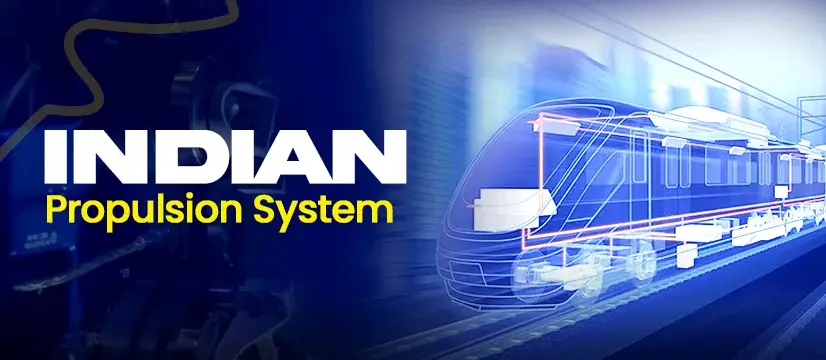
Ever wondered what makes a train so smooth, powerful and almost silent? And what actually makes it move? Well, that's the railway propulsion system, the heart of every locomotive and modern train. Simply put, propulsion is the engineering magic that converts energy—whether from coal, diesel, or electricity—into the raw force that turns wheels and hauls thousands of tons.
Propulsion isn't just about speed; it's the key to efficiency, lower emissions, and reliability. A good system saves millions in fuel, cuts pollution by up to 90% compared to diesel, and lets trains accelerate faster while hugging curves better. In India, where railways carry 8 billion passengers yearly, smarter propulsion means fewer delays, greener travel, and room for growth.
Let's First Understand the Basics of a Railway Propulsion System:
Think of a railway propulsion system like a car's engine and gearbox combined—but way more powerful. In simple terms, it's everything that turns energy into motion for a train. Fuel or electricity goes in one end, and smooth tractive effort (pulling force) comes out at the wheels.
Break it down into three main parts:
Prime Mover (Energy Source): The "fuel tank", which could be a diesel engine burning fuel onboard, overhead electric wires (25 kV AC in India), or even hydrogen fuel cells. This creates raw power.
Transmission/Power Conversion: The "brain." Converts that power into usable form. Diesel trains use generators to make electricity; electric ones use transformers and inverters to tweak voltage and frequency for smooth control.
Traction (Power at Wheels): The "muscles." Electric motors (traction motors) bolted to the axles spin the wheels, gripping rails to haul freight or passengers.
Key Components Include:
Power Collection and Protection:
Consisting of a pantograph, which is a diamond-shaped arm installed on the roof, pressing against 25 kV AC overhead catenary wires, and grabbing power through sliding carbon strips. Its quantity remains at two per 16-car train for redundancy. Right beside sits the Vacuum Circuit Breaker (VCB), instantly cutting power if lightning strikes or maintenance calls.
Traction Transformer
When the power drops to the underframe of Trailer Coaches (non-powered), the traction transformer here steps 25 kV down to ~950 V AC. One feeds two adjacent Motor Coaches. Think voltage like water pressure—too high fries electronics, too low lacks punch.
Power Electronics: Converters and Inverters
A Line & Traction Converters (LTC), placed under Motor Coach underframes, converts 950 V AC into DC via link capacitors. The DC is then Invert into variable-frequency 3-phase AC, along with handling of regenerative braking.
IGBT modules, which are transistors, are placed inside switches millions of times per second—modern brains enabling precise torque.
Traction Motors and Mechanical Drive
The payoff: 4 traction motors per Motor Coach, axle-mounted on bogies, convert electricity to torque, spinning wheels via gearboxes. Current returns via rail earthing brushes. Adhesion, which is just a grip, hits 35-40%—enough to pull 1,500 tons uphill.
Auxiliary Systems
This is meant for non-traction needs, where an Auxiliary Converter under Trailer Coach splits power: 415 V AC for HVAC/lights, 110 V DC for controls/toilets. Air compressor powers brakes; batteries handle emergencies. Roof-mounted units house relays and junctions.
Powered by Froala Editor
Stay Connected, Stay Informed –
Don’t miss out on exclusive updates, market trends, and real-time investment opportunities. Be the first to know about the latest unlisted stocks, IPO announcements, and curated Fact Sheets, delivered straight to your WhatsApp.