Hexagon Nutrition IPO Opens June 5: GMP, Price Band, Lot Size & Full Review
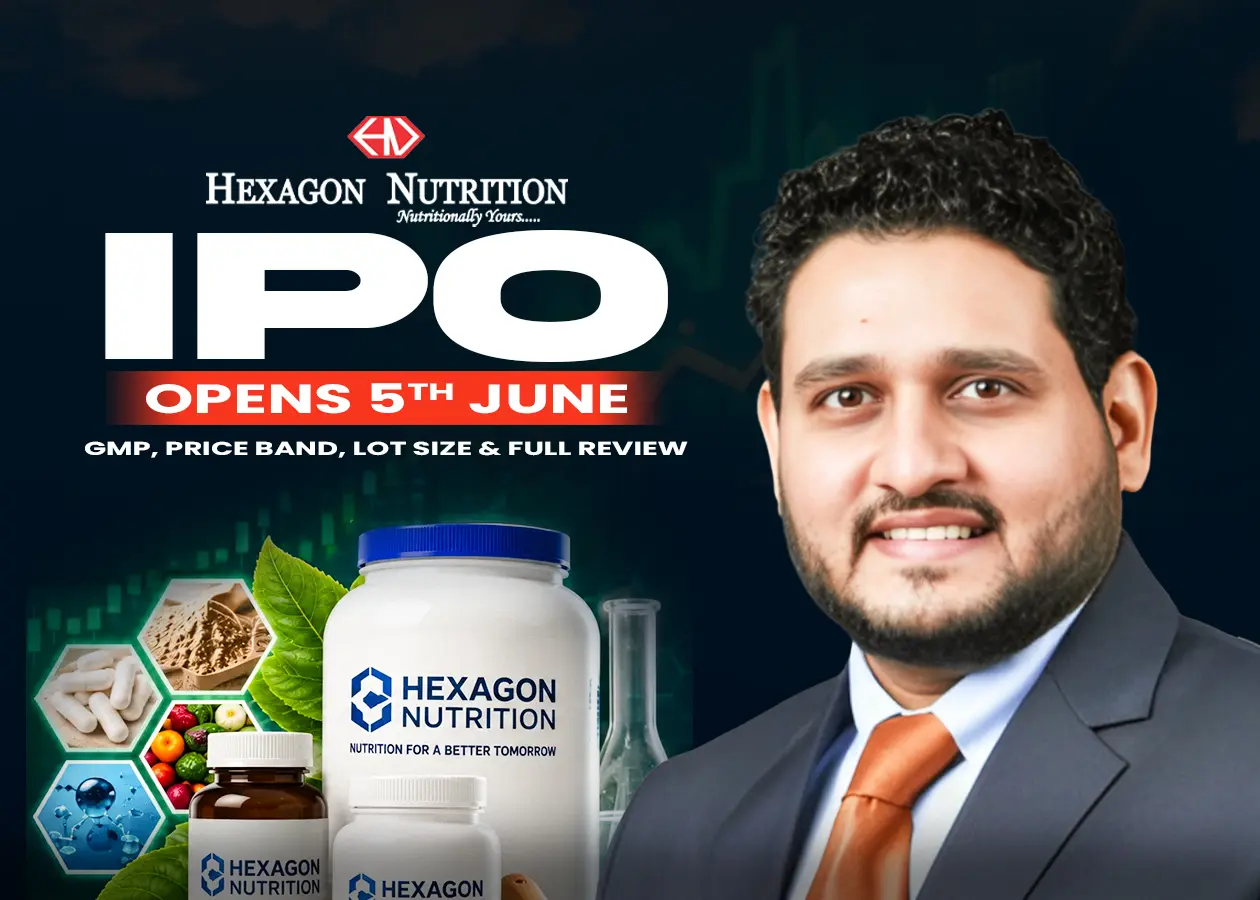


India's nutrition industry runs on companies most people have never heard of. You won't see Hexagon Nutrition trending anywhere online. No viral campaigns, no influencer tie-ups, no big brand moments. But if you've ever bought a protein supplement off a pharmacy shelf, or seen a family member recovering in a hospital with a clinical nutrition drink, or heard about therapeutic food being distributed in government nutrition drives chances are Hexagon's formulation work was somewhere in that chain.Hexagon Nutrition has been doing exactly this work since 1993. On June 5, 2026, its opening will happen to public investors for the first time.
This piece covers the Hexagon Nutrition IPO and everything worth knowing before you decide on the price band, lot size, financials, GMP, and an honest take on whether it makes sense for your portfolio.
Hexagon Nutrition IPO at a Glance
Parameter | Details |
IPO Open Date | June 5, 2026 |
IPO Close Date | June 9, 2026 |
Allotment Date | June 10, 2026 |
Refund/Shares Credit | June 11, 2026 |
Listing Date | June 12, 2026 |
Price Band | ₹42 – ₹45 per share |
Issue Size | ₹138.87 crore (OFS only) |
Lot Size | 333 shares |
Lead Managers | Cumulative Capital Pvt. Ltd. & Catalyst Capital Partners Pvt. Ltd. |
Hexagon Nutrition IPO GMP | ₹22 per share |
What Is the Hexagon Nutrition IPO GMP Today?
The Hexagon Nutrition IPO GMP is sitting at ₹22 per share in the grey market right now. With the upper price band fixed at ₹45, that puts the expected listing price around ₹67 which works out to roughly a 48.9% gain over the issue price if grey market sentiment holds. That's a number worth paying attention to, though GMP can shift quickly once subscription data starts rolling in.
This is a strong and meaningful GMP signal for a mainboard IPO of this size. It suggests institutional and retail demand in informal markets is pricing the stock well above its issue price ahead of subscription even opening.
Important caveat: GMP is an unofficial, unregulated indicator. It can shift sharply in the 24–48 hours before listing. Use it as one data point, not your sole investment thesis.
Investors tracking Hexagon Nutrition IPO share price in the grey market should monitor this closely as subscription data comes in across June 5–9, 2026.
Hexagon Nutrition Unlisted Shares & Pre-IPO Context
The Hexagon Nutrition IPO unlisted shares and Hexagon Nutrition IPO pre-IPO shares have been in limited circulation given the company's private status since 1993. The Kelkar family has retained control across three decades, building the business without external private equity dependency. With the earlier institutional investor no longer on the cap table, public market investors will now be the primary external stakeholders post-listing.
The absence of PE overhang and the family's long-term operational commitment are genuine positives for those evaluating Hexagon Nutrition pre-IPO shares as a long-term holding.
The Company: 33 Years of Nutrition Science
The company has been doing this since 1993. Started as a micronutrient formulations business, it has spent over three decades quietly expanding into one of the more complete nutrition companies India has produced. Today it runs three separate revenue streams, each serving a different part of the market.
The biggest piece is premix formulations; nearly half the company's revenue in FY25 came from here. What Hexagon does in this segment is make customized vitamin and mineral mixes that large food and beverage companies buy and blend into their own products. That fortified atta, that health drink with added iron and zinc, that breakfast cereal claiming extra vitamins the premix inside it very likely came from a company like Hexagon. The FMCG brand gets the credit. Hexagon just gets the purchase order. It's a steady, relationship-driven business where switching suppliers isn't easy once a formulation is locked in. That's the nature of a B2B2C model done well.
The second segment is branded nutrition products Hexagon sells directly under its own names like Pentasure, Obesigo, Pediagold, and Nutrone. The branded nutrition segment covers several different consumer needs under one roof. There are products built specifically for hospital patients on clinical nutrition support, products for people managing their weight, nutrition formulations designed for children, and general wellness supplements for everyday use. All of these reach customers through pharmacies, hospital procurement channels, e-commerce platforms, and the brands' own direct sales channels. This is the part of the business with the most upside as Indian consumers spend more on health, because brand margins are structurally better than B2B premix margins.
The third segment therapeutic nutrition accounts for about a quarter of revenue. This is ready-to-use therapeutic food and micronutrient powders, mostly going into government nutrition programmes and international humanitarian supply chains. It's not commercial in the traditional sense, but it gives the business volume stability and connects it directly to India's food fortification push and global health initiatives run through UN agencies and NGOs.
The geographic footprint is equally impressive. On the international side, the numbers are striking for a company most people haven't heard of. More than 61% of Hexagon's FY25 revenue came from exports. It sells into over 75 countries across Africa, Southeast Asia, the Middle East, Europe, and Latin America. It has offices in South Africa, Uzbekistan, and Hong Kong to manage those relationships.The manufacturing setup covers four plants in total.Three of those plants are spread across India Nashik, Chennai, and Thoothukudi. The fourth plant is in Tashkent, Uzbekistan. It runs inside a Special Economic Zone, so production costs there are lower and getting goods out to customers in Central Asia and Europe is a lot more straightforward than routing everything from India. For certifications, the company has FSSC 22000, ISO 9001:2015, GMP, and Halal the standard set of credentials you'd expect from a serious nutrition manufacturer selling into regulated international markets. Research happens at two in-house centres, one in Nashik and one in Chennai, both holding DSIR recognition, with 12 researchers working across them. Total headcount across the business stood at 527 employees as of March 2026.
Hexagon Nutrition IPO Financials: Profit Doubled in One Year
Metric | FY24 | FY25 | 9M FY26 |
Revenue (in ₹ Cr) | 305 | 331 | 275 |
PAT (in ₹ Cr) | 12 | 24 | 27 |
Debt/Equity | - | 0.18x | - |
The headline numbers tell a clear story. Now the financials. Revenue went from ₹278.5 crore in FY23 to ₹331.29 crore in FY25 that works out to about 9% growth each year. Modest on paper, yes. But this is a manufacturing business with long-standing client contracts and repeat institutional orders, not a consumer app chasing user numbers. In that context, nine percent year on year, without drama, without a down year in between, is a perfectly respectable track record. Not the kind of number that gets anyone excited at first glance but for a manufacturing company operating in a specialised segment with long client relationships and stable repeat business, that kind of consistent growth year after year is exactly what you want to see. It won't make headlines. But for a manufacturing business in a specialised segment, steady and consistent beats volatile and flashy most of the time. But look at what happened to profit in the same period. PAT went from ₹12.21 crore in FY24 to ₹24.38 crore in FY25 it doubled in a single year. That's not a fluke. That's what happens when a manufacturing business with heavy fixed costs crosses a certain revenue level and those costs stop eating margins as hard. The business was always capable of this profitability; it just needed the scale to unlock it.
The 9-month FY26 numbers are the most striking. In just the nine months ending December 2025, Hexagon reported ₹275.57 crore in revenue and ₹27.03 crore in PAT. Nine months in, and the profit already beats the full year of FY25. Stretch that to twelve months and you're looking at an earnings run rate well above ₹36 crore for FY26.
Debt-to-equity stands at a very clean 0.18x indicating minimal financial leverage and strong balance sheet quality. Net worth as of FY25 was approximately ₹195.6 crore.
Valuation at upper price band (₹45): At the ₹45 upper band, the market capitalisation is approximately ₹553 crore. On FY25 earnings of ₹24.38 crore, the P/E ratio is approximately 22.7x. On annualised 9M FY26 earnings, the forward P/E drops meaningfully making the forward valuation considerably more attractive. P/B ratio stands at approximately 2.48x on FY25 net worth. RoNW is 12.12%.
For a 33-year-old company with export revenues, global manufacturing, and accelerating profitability this is not an expensive issue.
IPO Structure: Fully OFS
The Hexagon Nutrition IPO is entirely an Offer for Sale (OFS) of 3,08,59,704 equity shares. There is no fresh issue component. The company will not receive any proceeds from the IPO.
The selling shareholders are all from the Kelkar promoter family:
Subhash Purushottam Kelkar (primary seller 2.41 crore shares)
Arun Purushottam Kelkar: 15 lakh shares
Nutan Subhash Kelkar: 36 lakh shares
Aditya Kelkar: balance
This is a promoter monetisation event. The Kelkar family is partially liquidating decades of value creation. On one hand, no fresh capital means the company's balance sheet doesn't improve post-IPO, and proceeds don't fund business expansion. On the other hand, the existing business has demonstrated profitability without needing additional capital which is actually a quality signal. It isn't raising money because it needs it; it is listing to create liquidity and market visibility.
Strengths: Why This IPO Deserves Attention
Three decades of institutional knowledge: Hexagon was founded in 1993. It has survived multiple economic cycles, built a 75-country export network, and maintained relationships with India's largest FMCG companies. This is not a business that launched two years ago to chase an IPO.
Export-dominant revenue: With over 61% of revenue coming from international markets, Hexagon is relatively insulated from domestic demand cycles. Export diversification across 75+ countries also limits geographic concentration risk.
Accelerating profitability: PAT doubling in one year is not a cosmetic improvement. It reflects the operating leverage that comes when a research-intensive, distribution-heavy business crosses a critical revenue threshold.
Clean balance sheet: The balance sheet is one of the cleaner ones you'll see at this scale. Debt-to-equity of 0.18x means the company is running almost entirely on its own money. There's no heavy borrowing sitting on the books, no interest burden eating into profits, no pressure to raise equity just to keep the lights on. If the business wants to grow, it has room to borrow without stress and given the profit trajectory, it increasingly has the internal cash flow to fund things on its own anyway.
B2C branded portfolio as optionality: The Pentasure, Obesigo, Pediagold, and Nutrone brands give Hexagon a consumer-facing layer with potentially superior margins as healthcare consumer spending grows in India.
Reasonable valuation: At ₹45, this is not a speculative premium issue. The issue price isn't ambitious. At ₹45, it's priced on what the business has actually delivered not on projections or potential. And the grey market seems to agree. A GMP of ₹22 before subscriptions have even opened tells you that people tracking this closely think the company is being offered cheaper than it's worth.
Key Risks & Concerns
OFS means no capital infusion: All IPO proceeds go to promoters. The company's ability to fund growth depends entirely on internal accruals and existing credit facilities.
Nashik facility reconstruction risk: The Nashik plant situation is the most immediate one. The company has flagged that a portion of that facility needs to be rebuilt following a regulatory requirement. While reconstruction is underway, there's a real possibility of production getting disrupted and any disruption at a manufacturing level eventually shows up in revenue numbers. How long it takes and how well the company manages output from its other plants in the meantime is something investors will need to watch after listing.
Raw material price volatility: Raw material costs are the second concern. The vitamins and micronutrients that go into Hexagon's products aren't sourced locally, they're traded globally, and their prices move. When input costs go up sharply, and there are no long-term supply contracts to cushion the blow, that pressure lands directly on margins. It's a structural vulnerability for any company in this space, not unique to Hexagon, but real nonetheless.
Export market regulatory exposure: Selling into 75 countries sounds like a strength and in many ways it is but it also means 75 different sets of rules to stay compliant with. One market updates its labelling standards. Another tightens import norms. A third changes quality testing requirements. Any of these, in a key export market, can create friction, delay shipments, or cost the company business. The more internationally exposed you are, the more of these situations you have to navigate at any given time.
Promoter family concentration: With the Kelkar family still holding significant control post-IPO and the CFO role within the family structure, governance depth will be a key watch item for public market investors.
Conclusion: The Investment Thesis in Plain Terms
Hexagon Nutrition has been around for 33 years. It makes money, carries almost no debt, and earns the majority of its revenue from outside India. Its listing on the mainboards at a price that reflects its actual financial performance. There's no disruption story here, no massive addressable market pitch, no loss-making startup hoping scale eventually fixes the unit economics. Just a company that has done the same thing consistently for three decades and gotten better at it over time. It is not a loss-making startup chasing scale.
It is a compounding business of the kind that does not make front pages but quietly builds shareholder value over 5 to 10 years. The category it operates in clinical and therapeutic nutrition, premix formulations, food fortification only grows as India's population ages, health awareness rises, and food safety standards tighten globally.
The GMP of ₹22 suggests near-term listing gain potential of approximately 49%. Whether that listing sustains or grows will depend on FY26 full-year earnings, subscription quality (particularly QIB participation), and overall market conditions in June 2026.
For long-term investors: the fundamental case is solid. For listing gain investors: the GMP signal is encouraging, but mainboard IPOs of this nature can be volatile on Day 1.
Verdict: Apply, suitable for both long-term investors and informed listing-gain seekers.
Tags
Stay Connected, Stay Informed –
Don’t miss out on exclusive updates, market trends, and real-time investment opportunities. Be the first to know about the latest unlisted stocks, IPO announcements, and curated Fact Sheets, delivered straight to your WhatsApp.


Planify Enterprises Private Limited
Planify Capital Limited
Licensed By




Registrations & Certifications
Mutual Fund License No.:
ARN-164419
IRDA Code (1):
ABLIC1003123454
IRDA Code (2):
ABLIC1003131639
Startup India Certificate No.:
DIPP93786
Other Websites
Address
MiQB, Plot 23, Sector 18 Maruti, Industrial Development Area, near Motherson Sumi Systems Limited, Gurugram, Haryana 122015


ⓒ 2016-2026 Planify. All rights reserved, Built with
in India


