Absolute Projects (India) Ltd: A Power EPC Contractor Heading to the Market


Kratika Agrawal
Associate Financial AnalystFinancial Analyst at Planify with CFA L2 credentials, focused on valuation modeling and identifying growth opportunities across unlisted and pre-IPO equities.
Category
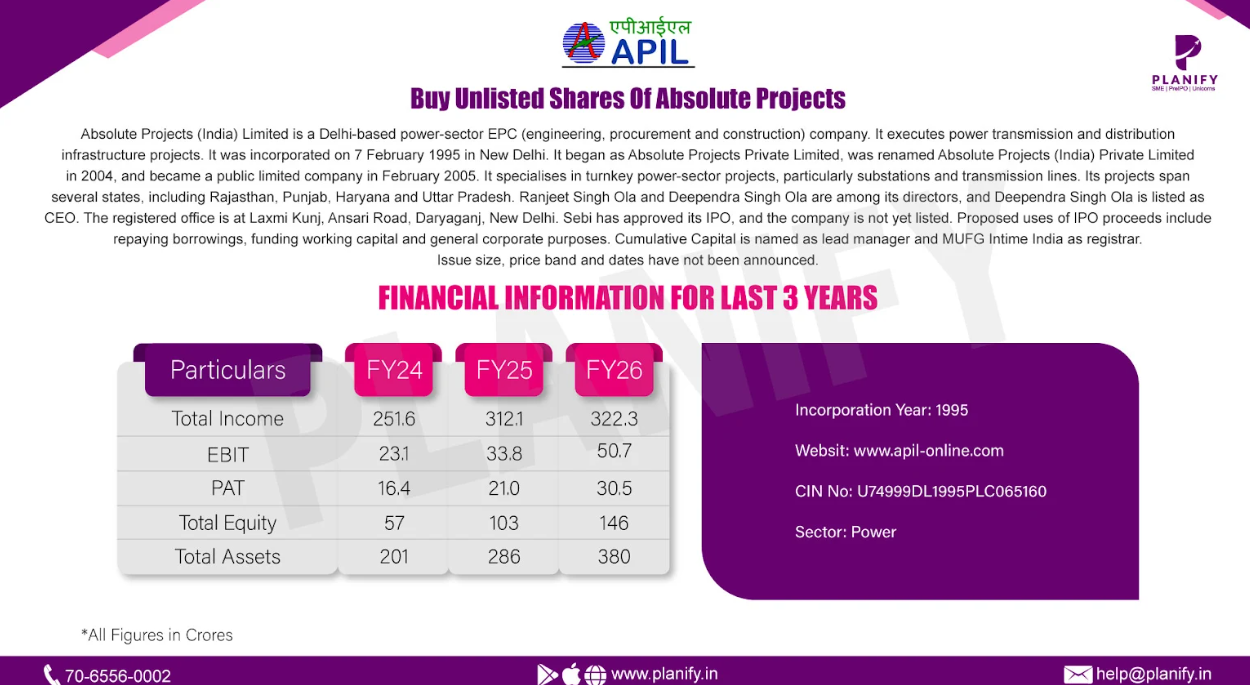
Absolute Projects (India) Limited (APIL) is a Delhi-based EPC (Engineering, Procurement & Construction) contractor for power projects, which has been approved by SEBI for an IPO of up to 2 crores of new shares. The FY26 year has been a year of significant increase in profits on the back of nearly stagnant revenues. However, it has been a year of high cash flow absorption through working capital requirements.
Key takeaways
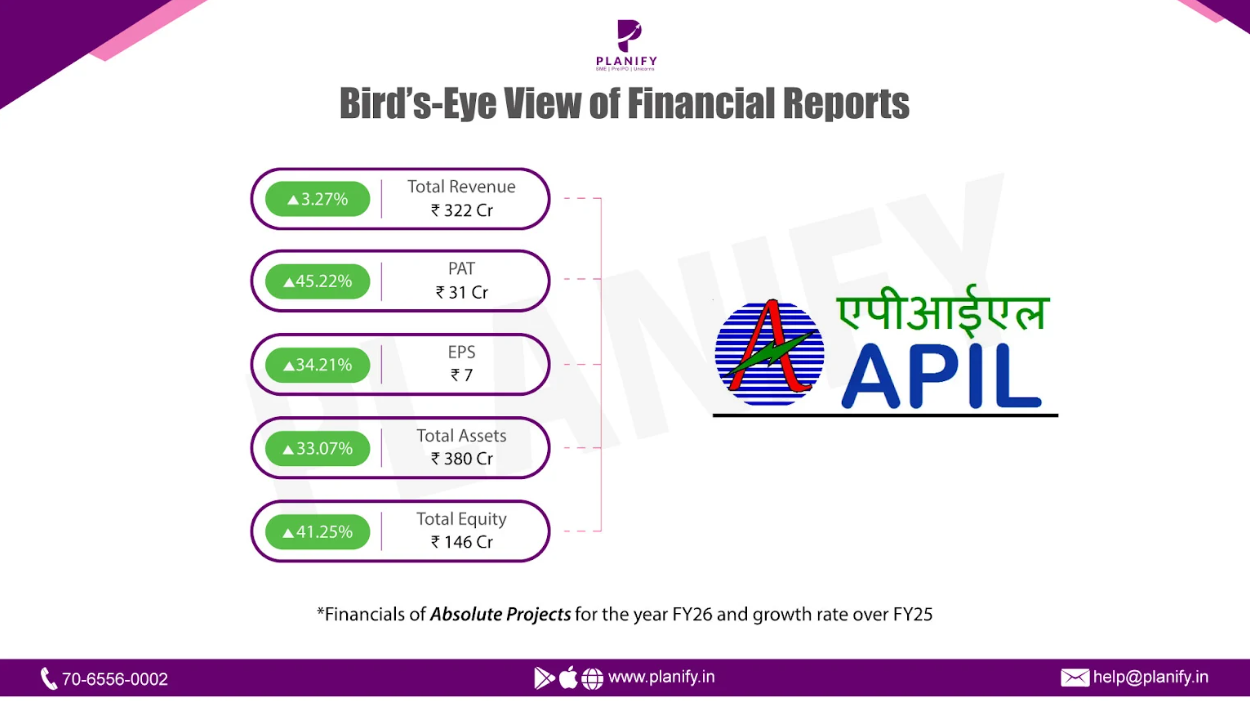
- While total income stood at ₹322 cr (+3%), the net profit increased by 45%, reaching ₹30.51 cr, due to expansion of EBITDA margin from 9.5% to 14.1%.
- Accounts receivable along with retentions were worth ₹215.7 cr (69% of the revenue), while operating cash flows showed a negative trend in the past two years.
- Debt has increased to ₹113.61 cr (3.7x increase compared to March 2024), and finance costs have more than doubled.
- As of December 31, 2025, the order book of Absolute Projects (India) Limited stood at approximately ₹747.53 crore.
- The firm is among 20 defendants involved in the pending CBI case. On the other hand, an existing tax issue has been pending, while the ROC has imposed multiple penalties related to governance issues.
- Concentration Risks: top 10 clients account for ~90% of revenue
What the company does
Its four business segments are:
- Projects for Power EPC: Transmission lines, substations, and distribution systems. This forms core business.
- In-house manufacture: Control panels, feeder poles, switchgears, towers, and substation structures.
- Civil construction works.
- Operational and Maintenance Services (O&M).
It was registered as a company on 7 February 1995 as Absolute Projects Private Limited. It became a publicly held company in 2005.
Where it sits in the power value chain
- Generation. This is where electricity is generated using sources such as coal, gas, water, wind and sun.
- Step-up Transformer. This happens immediately after generation where a transformer increases the voltage to a very high level. Electricity carried in very high voltage experiences very low levels of heat loss during the flow, just like a crowd moving fast and with little jostling through a tight but fast tunnel.
- Transmission Lines. Steel towers carry the electricity at voltages ranging from 138kV to 765kV (1kV=1000v) over long distances. There are some factories whose electricity supply is direct at this stage.
- Step down Substation. Just outside the city, there is where the voltage is reduced to a lower level of safety.
- Distribution. This is where the electricity is distributed in stages: sub-transmission customers (26kV and 69kV, examples being large industries), Primary customers (13kV and 4kV, examples being medium size industries) and Secondary customers (120v and 240v meaning your homes and small business).
The transmission towers and lines of APIL are found at step 3, the substations at step 4 and distribution network and feeders pillars at step
Company timeline
Year | Milestone |
|---|---|
1995 | First EPC contract |
1999 | First government order |
2001 | 220 kV switchyard extension |
2005 | Rural electrification work |
2008 | Manufacturing facility set up |
2009 | Switchyard line shifting project |
2011 | 132 kV substation |
2017 | Revenue crosses ₹100 crore |
2019 | Revenue crosses ₹200 crore |
2022 | First Nepal order |
2022 | First GIS project (gas-insulated substation: costly, mostly used in cities where space is scarce) |
2025 | Revenue crosses ₹300 crore |
2025 | First 220 kV AIS project (air-insulated substation: cheaper, mostly used where space is plentiful) |
2026 | Consent to establish Manufacturing Facility II |
2026 | Awarded order for 400 kV line bays (the sections of a substation where an incoming or outgoing line connects) |
2026 | L1 (lowest) bidder for a PGCIL project worth ₹275 crore+ |
Industry backdrop
IMARC Group reports that the EPC market of power in India increased from US$23.8 billion in 2025 to US$25.7 billion in 2026 and is projected to grow to US$41.5 billion by 2034 at a CAGR of 6.14% during 2026-2034. The increasing demand for energy projects and storage investments, as well as government efforts, are contributing to the market growth. There are significant amounts of solar and battery storage projects being constructed, which increase grid stability requirements.
The IPO
The IPO has been approved by SEBI but has not yet gone live. Both Absolute Projects and Jindal Supreme received approval from SEBI to conduct their IPOs (announced in July 2026), and the firm has issued its Draft Red Herring Prospectus (DRHP) on 30 March 2026. However, details about the opening date, price range, size of the issue, and lot size are still to be disclosed.
- Structure: a brand-new issue of up to 2 crore equity shares without any offer for sale, hence all proceeds from the IPO will go to the company, and no existing shareholders will sell their stakes.
- Type: Book-building, with face value of Rs. 2 per share and proposed listing on the BSE and NSE.
- Reservation: up to 50% for QIBs, at least 15% for non-institutional investors and at least 35% for retail investors.
- Use of Proceeds: Repayment/Prepayment of borrowings, working capital and other corporate purposes.
- Intermediaries: Cumulative Capital Private Limited acts as a book-running lead manager, while MUFG Intime India Private Limited acts as a registrar.
Financial analysis (FY26)
Profit and loss
₹ crore | FY26 | FY25 | Change |
|---|---|---|---|
Revenue from operations | 314.55 | 306.67 | +2.6% |
Other income | 7.79 | 5.45 | +43.0% |
EBITDA (excl. other income) | 44.42 | 28.98 | +53.3% |
Finance costs | 9.73 | 4.53 | +114.7% |
Depreciation | 1.52 | 0.66 | +129.7% |
Profit before tax | 40.96 | 29.24 | +40.1% |
Net profit (PAT) | 30.51 | 21.00 | +45.3% |
EPS (₹, post-split) | 7.18 | 5.35 | +34.2% |
Margins | FY26 | FY25 |
|---|---|---|
EBITDA margin | 14.1% | 9.5% |
PBT margin | 13.0% | 9.5% |
PAT margin | 9.7% | 6.9% |
While revenues increased by just 2.6%, the net profit was up 45%. This increase in profit was due to increase in margins as total costs remained unchanged (₹281.4 cr versus ₹282.9 cr) despite revenues increasing, due to reduced costs of purchased materials which went down by 25% to ₹147.1 cr and manufacturing and construction costs by 41% to ₹26.1 cr.
Revenue mix
₹ crore | FY26 | FY25 | Change |
|---|---|---|---|
Domestic power transmission projects | 104.42 | 155.26 | -32.7% |
Domestic manufacturing and allied | 89.40 | 50.24 | +78.0% |
Domestic civil construction | 41.96 | 10.78 | +289% |
Domestic O&M | 8.44 | 6.43 | +31.2% |
Export transmission projects | 22.98 | 39.97 | -42.5% |
Export manufacturing | 0.00 | 8.01 | -100% |
Foreign branch transmission sales | 47.35 | 35.98 | +31.6% |
Total | 314.55 | 306.67 | +2.6% |
Transmission (domestic, export and foreign branches) declined by ₹231.21 cr to ₹174.75 cr (-24.4%) and now account for 55.6% of income compared to 75.4% last year. Manufacturing and civil works picked up the slack. While this is evidence that the company is diversifying its operations, these sectors are less visible.
Customer mix: government versus private
The contribution of government activities such as Nepal Electricity Board was 53% in the first six months of FY26 compared to 61% in FY24.
₹ crore (% of revenue) | H1 FY26 (Apr–Sep 2025) | FY25 | FY24 | FY23 |
|---|---|---|---|---|
Government undertakings | 72.09 (53.09%) | 174.95 (57.05%) | 151.56 (61.05%) | 62.88 (44.60%) |
Private | 63.71 (46.91%) | 131.72 (42.95%) | 96.69 (38.95%) | 78.12 (55.40%) |
Total | 135.80 | 306.67 | 248.25 | 140.99 |
Key ratios
Ratio | FY26 | FY25 |
|---|---|---|
Return on equity (average) | 24.5% | 26.3% |
ROCE (EBIT / equity + debt) | 19.5% | 17.6% |
Debt / equity | 0.78x | 0.86x |
Interest cover (EBIT / finance cost) | 5.2x | 7.5x |
Current ratio | 1.95x | 1.87x |
Receivable days (trade, year-end) | 136 | 80 |
What looks good
- Good profitability. EBITDA margin increased by 4.6 percentage points, while ROE is around 24%.
- Growing equity. Shareholder funds have increased by 41% owing to ₹37.6 cr of equity capital raised over two years, and debt/equity ratio is less than 1x.
- Healthy interest coverage of 5.2x, though cover is decreasing.
- Clean audit report. No qualification and no cases of any fraud detected by auditors.
- Decrease in tax risk. Income assessed for the year ended 2017-18, which was revised on remand by ITAT, came down from ₹32.4 cr to around ₹4.5 cr.
What to watch
- Cash conversion remains the principal concern. Operating cash flow was negative in both years, about ₹99.9 cr cumulatively.
- Receivables and retention money went up to ₹215.7 cr, which is 69% of revenue compared to 41% last year. Retention money is about ₹98.43 cr, up 69%, and it has been noted by the auditor as the material key audit matter. Receivable turnover decreased from 7.2x to 3.4x.
- Debt finances working capital. Borrowings have grown to about 3.7 times the March 2024 level of ₹31 cr, and interest expenses have more than doubled.
- Earnings quality. Non-operating income is 19% of profit before taxes. ₹5.71 cr (14% of PBT) is unrealized foreign exchange gain which is non-cash.
- Contingent liabilities amount to ₹50.42 cr and are bank guarantees exclusively. In the light of about 35% of equity, that is a fairly standard practice for EPC companies, although contingent liabilities remain liquidity claims.
- Revenues concentration is changing. The core domestic transmission segment revenue has fallen 33%.
Litigation and regulatory overview
- Criminal: This is one of the twenty cases, which include both individuals and three other corporations, that are pending as CBI vs. Ashish Gupta & Ors. (Reg. No. 40/2024, CNR DLCT120000772024), before ACJM-05, Rouse Avenue Courts, Delhi. The charges are IPC Sections 120B, 420, 467, 468 and 471 (conspiracy, cheating and forgery). The suit was filed on 26 February 2024 and the case remained pending as on 8 October 2026 with interim orders passed without any findings of guilt against the company. The exact charge levelled against the company is not given in the case summary.
- Tax: In DCIT vs. Absolute Projects (India) Ltd. (ITA No. 89/Del/2024, AY 2017-18), the tax officer alleged profit shifting from Noida unit to the tax-exempt Roorkee unit (Section 80-IC) and increased the income by about ₹28.3 cr. ITAT Delhi, on 12 December 2024, has set aside the first appellate order and remanded the case. In fresh assessment of 20 March 2026, the 80-IC has been curtailed and the total income assessed is ₹4.52 cr compared to ₹32.44 cr in original assessment. Penalty proceedings have been initiated under Section 270A.
- The corporate law: The ROC Delhi has punished the company under Section 450 of the Companies Act, 2013 for the following violations: Non-dematerialisation of the securities and failure to get the ISIN code, which is a continuous violation for 2,252 days, and ₹23.02 lakh is charged against the company and ₹5.50 lakh against each defaulting officer. Delay of 2,784 days in appointing two independent directors under Section 149(4), ₹3 lakh charged against the company and ₹1 lakh charged against each of three officers. The fines imposed are small, but collectively they indicate a lack of compliance and governance. The ongoing criminal investigation and the outstanding tax penalty cases are conditional risks that deserve attention.
Conclusion
APIL brings together 30 years of experience, increasing margins and favorable industry conditions with an elongated working capital cycle, increasing leverage and a highly detailed legal and compliance dossier for a business just before it is about to be listed. For investors, the legal cases disclosed in the DRHP, the price range and the fact that receivables and retention monies are getting converted into cash will carry more importance than profitability.
Sources: Annual Report FY2025-26 (standalone audited financials); eCourtsIndia; ITAT Delhi order dated 12 December 2024; ROC Delhi adjudication orders; Business Standard and SEBI (IPO approval and DRHP); IMARC Group; Jyoti Structures FY26 results and exchange filings via public data aggregators. Legal-case status is as of the dates stated and should be verified against official court and MCA records before publication.
Tags
Stay Connected, Stay Informed –
Don’t miss out on exclusive updates, market trends, and real-time investment opportunities. Be the first to know about the latest unlisted stocks, IPO announcements, and curated Fact Sheets, delivered straight to your WhatsApp.