China Tightens Its Grip on Solar Know-How, and India Feels the Squeeze


Kratika Agrawal
Associate Financial AnalystFinancial Analyst at Planify with CFA L2 credentials, focused on valuation modeling and identifying growth opportunities across unlisted and pre-IPO equities.
Category
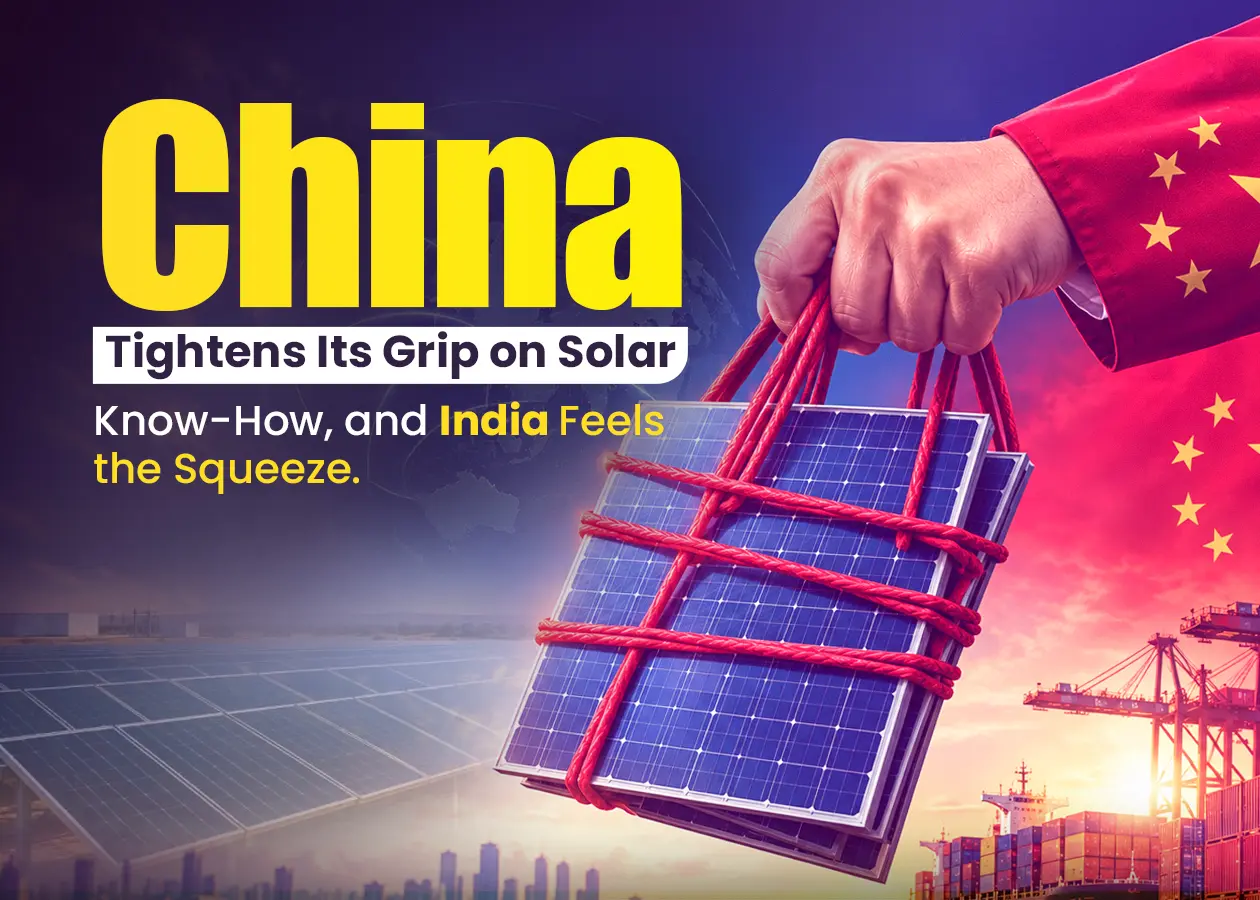
China is still happy to sell solar panels to the world. What it now wants to protect is the technology and equipment used to make them.
What China proposed
China announced export controls on 12 technologies used in solar manufacturing citing national security issues on October 16, 2026. The technologies can be categorized in two groups:
- Export bans include the latest technology that includes Perovskite and tandem cells, ultra-thin silicon wafers (70 micrometers or less), and the cheaper way of manufacturing polysilicon.
- Licenced exports include the cell technologies used in new plants, including TOPCon, HJT and Back Contact Cells.
These regulations are still under discussion, with a comment period running until November 15, 2026. Nonetheless, the firms in China have to register with the government first in order to export the technologies. Finished modules, cells and wafers will not be banned.
Why India is exposed
A solar panel is made in four stages: polysilicon, wafer, cell, and module. India is strong at the last stage, assembling modules, but weak at making cells, the stage where sunlight is actually converted into electricity.
The numbers show how lopsided this is. According to Reuters, Indian companies have built around 200 GW of module capacity but produce only 27 GW of cells, and the government’s own estimates also show module capacity far exceeding cell capacity. As a result, India imports about 95% of its solar cells from China.
The ALMM List-II policy makes this gap a pressing problem. It requires government-sponsored projects to use Indian-made cells, with rooftop and open-access projects getting a grace period until the end of 2026. Since domestic cell supply falls far short of what module makers need, all the major manufacturers are now racing to build their own cell lines. Ironically, most of these rely on Chinese technology and labor, which ties back to China’s growing effort to protect its manufacturing know-how and equipment.
The curbs are not entirely new
Indian manufacturers claim that pressure has been increasing. According to Reuters, China has limited its exports of technology for the production of solar cells, technical assistance and equipment. Also, it is expected that six producers will face delays in the start of cell plant production because of these restrictions. The sources did not want to be named because of their concern about retaliation from Beijing. The same source claims that nearly a third of India’s 140 panel producers have stopped their production, and the other two thirds have reduced it to three or four days a week.
Furthermore, GTRI, an Indian think-tank, suggests that Chinese limits of imports of inputs and machinery could be a reaction to the visa and investment restrictions imposed by India.
Who is hurt most
The impact is not the same across all companies.
- Existing factories are mostly protected. The danger lies in servicing: the provision of spare parts, upgrades and technician visits will now require Beijing’s permission, slowing down maintenance work.
- The most threatened factories are those currently being built. Starting up a new line requires Chinese engineers to come and install and activate it. Should each visit require a license, delays are inevitable and expenses increase.
- Expansion plans into wafers and polysilicon become more challenging. India plans to mandate the use of domestically produced wafers from June 2028, but the technologies that have been banned by China are the very technologies needed to achieve that goal.
This creates an irony of its own kind. Delays lead to the continued shortage of cells, and shortage helps those whose cell lines are already operating. Wood Mackenzie forecasts that Indian utility-scale solar power system prices will increase by around 20% till the end of 2026 due to the cell shortage.
Alternatives to China
No one country can serve as an alternative to China, but alternatives do exist at every step.
- Polysilicon: German, Malaysian, American and Japanese suppliers can provide polysilicon at a higher price and in smaller quantities.
- Wafers: nobody else does it on a mass scale. India will continue to import Chinese wafers, as they are not included in the list of controlled products.
- Cell equipment: European, Korean, Japanese and American manufacturers can assist, but their equipment costs more, they have long delivery times, and cannot equip several plants simultaneously.
The GTRI suggested that India develop cooperation with Japan and South Korea regarding components. The most probable scenario is that India will negotiate licenses for controlled technologies, purchase some production lines from other companies and invest more in R&D.
What to watch
- Final regulations following the November 15th deadline for comments.
- Whether Indian companies will get their export licenses, and how soon.
- Disclosure by the companies on the status of delivery and installation of the cell equipment.
- Whether the government changes the deadline of December 31 if supplies continue to be scarce.
Bottom line
China isn’t cutting off solar components. It’s making it harder for other countries to produce them. For India, the real risk isn’t current output but future growth, which could be slower and costlier than expected.
Tags
Stay Connected, Stay Informed –
Don’t miss out on exclusive updates, market trends, and real-time investment opportunities. Be the first to know about the latest unlisted stocks, IPO announcements, and curated Fact Sheets, delivered straight to your WhatsApp.


Planify Enterprises Private Limited
Planify Capital Limited
Licensed By




Registrations & Certifications
Mutual Fund License No.:
ARN-164419
IRDA Code (1):
ABLIC1003123454
IRDA Code (2):
ABLIC1003131639
Startup India Certificate No.:
DIPP93786
Other Websites
Address
MiQB, Plot 23, Sector 18 Maruti, Industrial Development Area, near Motherson Sumi Systems Limited, Gurugram, Haryana 122015


ⓒ 2016-2026 Planify. All rights reserved, Built with
in India


