


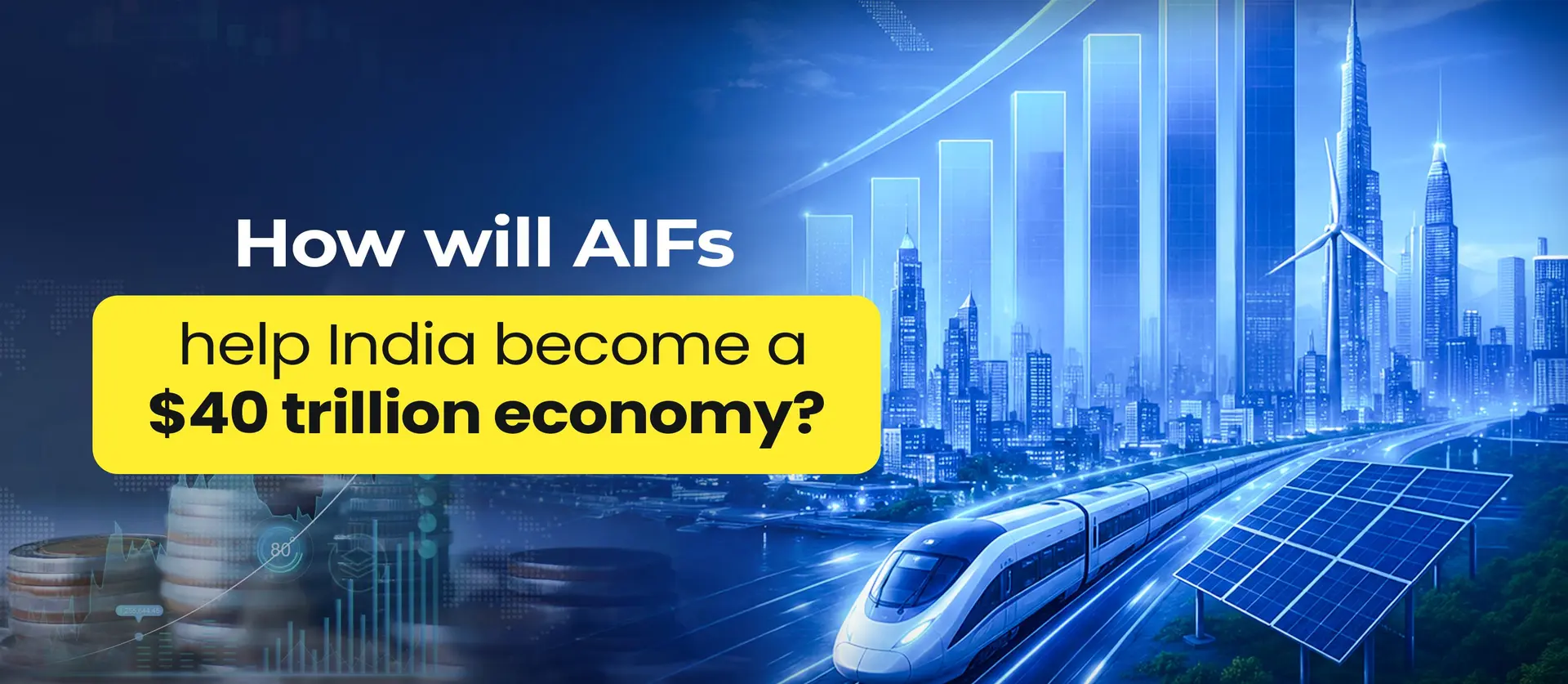
How will AIFs help India become a $40 trillion economy?
Written by: Diksha Kalra
Published: Sep 16, 2026
Updated: Sep 16, 2026
6 min read
For India to become a $40 trillion mega-economy by 2050, it is not possible through traditional and public means alone. Reaching this ambitious goal requires transformational change in how capital is deployed. Alternative Investment Funds (AIFs) can help India achieve its goal.
Private Credit and Venture Capital
For decades, mid-market Indian companies were trapped in the financials of traditional methods. If you were a fast-growing company but lacked a corporate loan from a bank, it was a nightmare. Nowadays, things have changed, and new methods have arisen; these aren't standard, rigid bank loans. They are known as “private credit” and “venture capital”.
Private Credit: This is a Category II AIF, which gives debt to fast-growing companies that banks' slow process can’t see. They don't obsess over physical collateral. Instead, they look at operational cash flows, contracts, and intellectual property.
Venture Capital: It's a part of Category I AIFs; they even go further than private credit. Instead of giving debt, they give them capital and become their partners in the growth of the company. The investment approach is not a cash flow or even a running business; it’s just a simple idea.
By absorbing these complex risks, private credit and venture capital prevent high-potential businesses from being delayed. Just as importantly, it acts as a shock absorber for the broader economy, shifting risk away from the public banking sector and making the entire financial system way more resilient.
Powered by Froala Editor
Let’s be honest: India cannot become a global superpower by just being the world's IT capital and building copycat apps. True economic dominance requires home-grown intellectual property (IP), but building semiconductor fabs, launching aerospace startups, or engineering biotech solutions requires a massive amount of funding and years of no revenue.
With the support of venture capital and the government, both can afford to stick with a deep-tech startup through a 7-to-10-year R&D cycle. This collaboration provides domain experts who understand engineering without chasing profit for a short period of time. This is what transforms India from an importer of technology into a nation that exports global innovations. To become the world’s superpower, this combination of Venture Capital and the Government helps the United States
Powered by Froala Editor
An economy cannot compound its growth if tens of billions of dollars are locked up in broken corporate balance sheets, stalled real estate projects, and non-performing bank loans.
Special Situation Funds (SSFs) serve as economic rescue organizations. Instead of letting valuable businesses rot in bankruptcy court for years, these funds buy them. They step in as active partners, investing emergency working capital, cleaning up messy corporate governance, restructuring broken debt, and bringing in fresh management teams to turn them around.
Powered by Froala Editor
To become the $40 trillion superpower, require high-speed rail corridors, world-class ports & airports, massive expressways & highways, data centres, and multi-gigawatt clean energy grids. India requires trillions of dollars.
Historically, India tried to fund 20-year infrastructure projects using commercial bank loans or bonds. Infrastructure AIFs have completely re-engineered this by acting as a sophisticated investor. Global institutional players like sovereign wealth funds and massive international pension pools want to take part in India’s growth story, but they don't want execution or regulatory risk. Infrastructure AIFs act as the medium for long-term capital into professionally managed vehicles. Because the fund durations naturally align with the long lifecycles of the infrastructure assets, development can move forward smoothly without threatening the stability of domestic banks.
Job creation
GDP growth on paper is meaningless if it doesn't change livelihoods. Every single rupee deployed by an alternative fund acts as a direct employment catalyst. By simultaneously funding cutting-edge innovation and heavy physical infrastructure, AIFs create a balanced jobs ecosystem. This continuous job creation keeps the purchasing power of India's massive working population growing, which is, ultimately, the core engine required to sustain a multi-trillion-dollar economy.
Powered by Froala Editor
Reaching a $40 trillion GDP isn't going to happen through banking growth or minor policy changes. It requires a financial infrastructure sophisticated enough to fund high-risk innovation, clean up broken assets, and absorb long-term project timelines. Companies like Alpha AMC that invest in SMEs need to become big enough that Indian entrepreneurs don't look for traditional methods to raise capital; instead, they want investment from these firms.
Powered by Froala Editor
Stay Connected, Stay Informed –
Don’t miss out on exclusive updates, market trends, and real-time investment opportunities. Be the first to know about the latest unlisted stocks, IPO announcements, and curated Fact Sheets, delivered straight to your WhatsApp.


Planify Enterprises Private Limited
Planify Capital Limited
Licensed By




Mutual Fund License No.:
ARN-164419
IRDA Code (1):
ABLIC1003123454
IRDA Code (2):
ABLIC1003131639
Startup India Certificate No.:
DIPP93786
Other Websites


ⓒ 2016-2026 Planify. All rights reserved, Built with
in India


