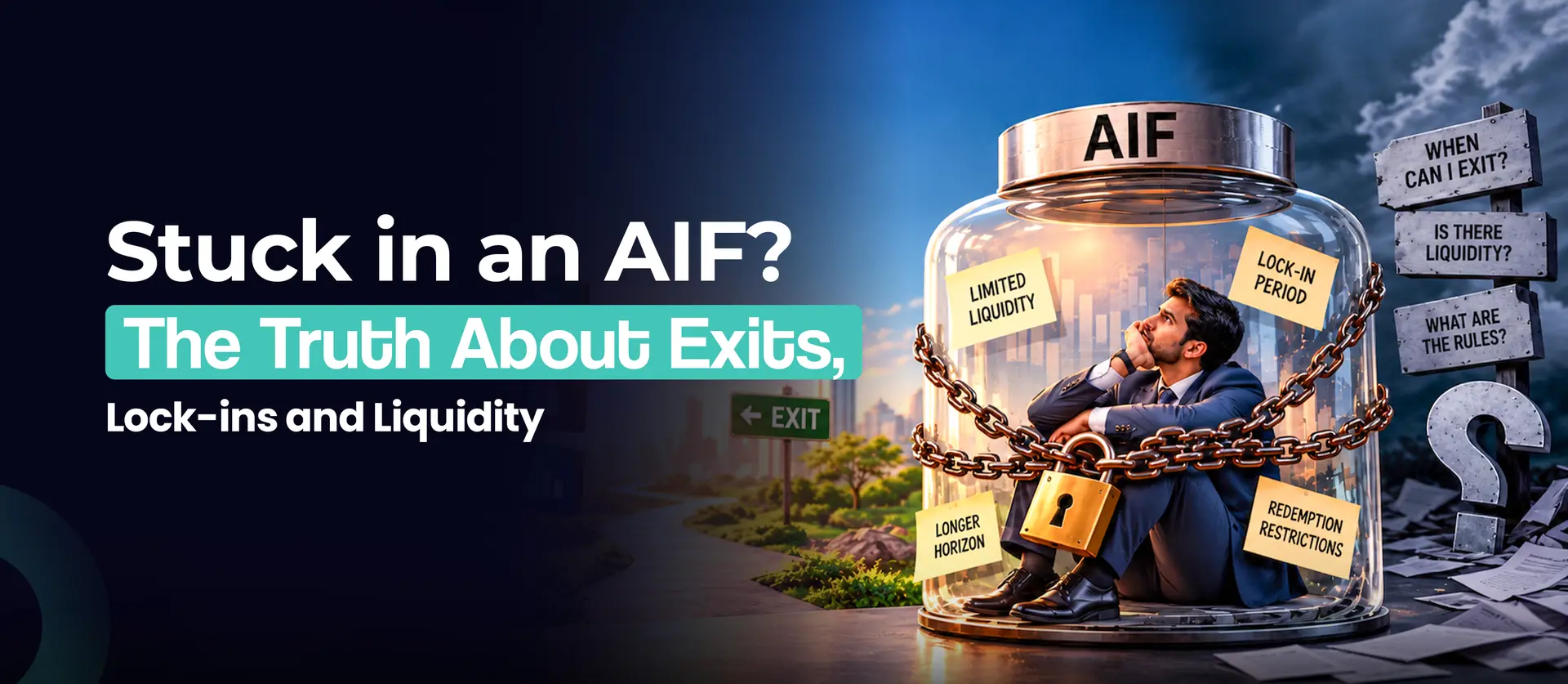
Stuck in an AIF?

Devansh Singhal
Financial Analyst InternCFA Level 3 Candidate and Undergraduate from University Of Delhi with a strong interest in equity research and Financial statement analysis.
Category
The Truth About Exits, Lock-ins and Liquidity
With a mutual fund, you can usually redeem units on any business day. Most AIFs do not work that way.
Units of Category I and Category II AIFs are unlikely to be freely redeemable or transferable, because these funds make long-term, illiquid investments. The fund manager needs time to find deals, build the portfolio, grow the investments and then sell them. Your money is committed for that whole journey. If a manager cannot secure the 75% consent required for a Dissolution Period or a voluntary in-specie rollout, SEBI mandates that the remaining assets must be distributed in-specie to investors without further approval.
Tenure: how long is your money tied up?
Category I and Category II AIFs must be close-ended with a defined tenure of at least 3 years. In practice, scheme tenures typically run from five to ten years, depending on the strategy. The exact term is written in the fund's Private Placement Memorandum (PPM).
Category III AIFs (such as long-short and hedge-style strategies) can be open-ended or close-ended, and their redemption terms vary. Some allow periodic redemptions, but usually with notice periods, exit loads or lock-ins. Always check the PPM.
Sometimes the manager cannot sell the investments by the end of the tenure. Here is what the rules allow:
Extension of up to two years. A close-ended scheme's tenure can be extended by up to two years, but this needs the approval of two-thirds of unitholders by value. The extension is typically done in one-year steps.
If consent is not obtained. The scheme must fully liquidate within one year of its original tenure expiry.
Extensions beyond two years. Large value funds for accredited investors are permitted to extend beyond two years.
Carrying forward unsold assets. SEBI has allowed AIFs to close an existing scheme and move unliquidated investments to a new scheme with consent from 75% of investors by value. Valuation is disclosed to investors as part of the process.
Distribution in-specie. The manager may distribute unsold assets to investors directly, instead of cash, again with the required investor approval. This means you could receive shares or other securities rather than money.
Investor consent has limits too. during the official Dissolution Period, AIF managers cannot charge any management fees .SEBI has held that investor consent cannot be used to extend an AIF scheme beyond the tenure and liquidation framework in the regulations. The rules in this area have been changing, and recent industry summaries mention a dissolution period and a new inoperative fund status introduced through 2026 amendments and a circular. Please check the latest SEBI circulars or ask your distributor for the current position before you rely on this.
When do you actually get money back?
Money returns through distributions, not a single payout at the end. A typical pattern looks like this:
Early years: the fund calls capital and invests. Fees are charged, but the portfolio is still young, so reported returns can look flat or negative. This is known as the J-curve.
Middle years: investments mature and start generating income or partial exits.
Later years: the bigger exits happen, and most distributions arrive.
The timing is never guaranteed. A delayed exit by one portfolio company can push back distributions for the whole fund. Treat any projected timeline as an estimate, not a promise.
Early exit is possible in some cases, but rarely simple:
Transfer to another investor. Transfers of AIF units typically need prior consent from the AIF manager, who must also complete KYC on the incoming investor.
Secondary sale. You may find a buyer, but a lack of ready buyers often means selling at a discount to the fund's reported value.
Redemption (Category III). Where allowed, redemption follows the fund's notice period and any exit load.
Manager discretion. Some funds may permit early exits only in special circumstances, as per the fund documents.
The key point is that early exit is never a right you can assume. It depends on the PPM, the manager's approval and market demand.
Liquidity planning: balance the rest of your portfolio
Because AIF money is locked up, the rest of your finances must be able to carry you through. A few practical rules:
Invest only surplus money that you will not need for emergencies, tax payments or large expenses during the fund's life.
Keep readily available funds for capital calls. Missing a call has real consequences, as we covered in our article on capital call defaults.
Do not size your AIF allocation by the ₹1 crore minimum alone. Check that the commitment is a comfortable share of your total investable assets.
Stagger your commitments. Spreading investments across different vintages can smooth out distributions over time.
Plan for delays. If the PPM says seven years, make sure your finances still work at nine.
5 questions to ask before you invest
What is the fund's tenure, and what extensions are possible?
Is there any lock-in, and are early exits or redemptions allowed at all?
How and when will distributions be made, in cash or in-specie?
What happens if the fund cannot exit its investments on time?
What are the transfer rules, fees and approvals if I want to sell my units?
Entering an AIF is easy, but exiting needs a plan from day one. Understand the tenure, the extension rules, how distributions work and what early exit really involves, then check that your wider finances can handle the lock-in. The best AIF investors plan their exit before they make their entry.
Disclaimer: This article is for educational purposes only and is not investment, legal or tax advice. AIF investments are subject to market risks and returns are not guaranteed. Tenure, exit, redemption and distribution terms differ across funds and categories, and regulations may change. Please read the PPM and fund documents carefully and consult your advisor before investing.
Tags
Stay Connected, Stay Informed –
Don’t miss out on exclusive updates, market trends, and real-time investment opportunities. Be the first to know about the latest unlisted stocks, IPO announcements, and curated Fact Sheets, delivered straight to your WhatsApp.