


The Future of Venture Funds in India: Unicorns, Decacorns and Beyond
Written by: Diksha Kalra
Published: Sep 16, 2026
Updated: Sep 16, 2026
7 min read
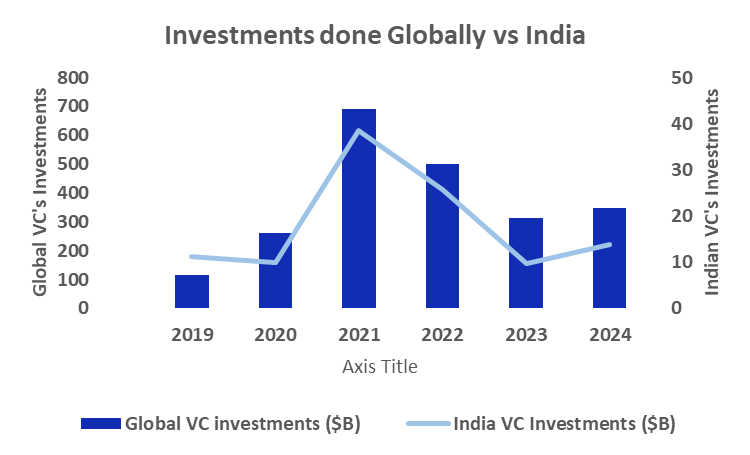
Venture Capital (VCs) support startup growth in India by providing new founders with guidance and financing for early-stage, high-growth firms in exchange for equity. In India, Indian venture capital firms are a vital part of startup expansion, as many founders do not have access to traditional bank lending due to their high-risk profile. In the last few years, we have seen larger Series C investments becoming greater trends: Mammoth corporations and the top VCs in India, including Blume Ventures, Matrix Partners India, and Peak XV Ventures (formerly known as Sequoia Capital) are hitting the market in a big way. They are challenging the norm, and with their venture funds and backing from the Indian government, they are working as an accelerator for founders to take their growth to the next level.
To understand VC deal sizes in India, Series A to Series C rounds have expanded nearly 3x between 2020 and 2025, signaling investor confidence in scalable innovation. These insights also highlight how top venture capital firms in India are driving growth by writing larger tickets and mentoring founders for long-term success.
Powered by Froala Editor
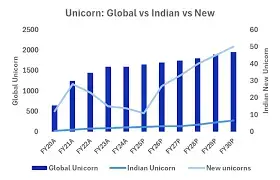
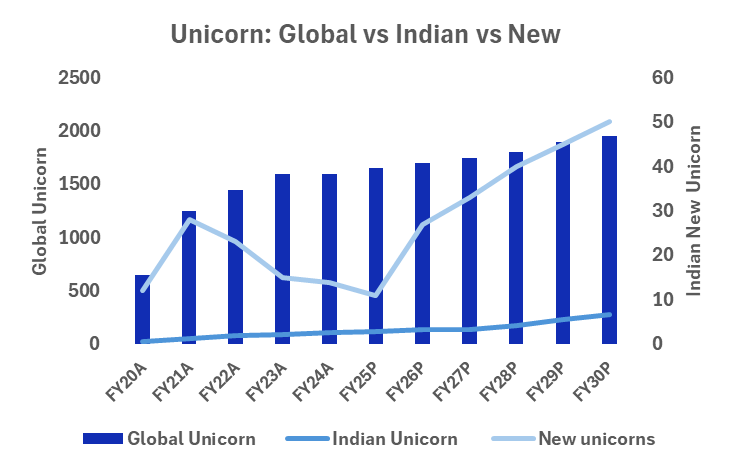
- The first achievements of India’s venture startups valued at $1 billion or more are InMobi in 2011, followed by Flipkart and Snapdeal. Since then, India has produced more than 110 unicorns across fintech, such as “Razorpay, PhonePe”; in SaaS, with “Freshworks”; in logistics, Delhivery”; in e-commerce and quick commerce, “Zepto”, “Boat” and “Meesho”; in direct-to-consumer retail, “Nykaa”; and in AI, we have “krutim” as a Unicorn
- Unicorns validate the small number of outsized successes, offsetting risks from other portfolio companies. They also generate employment, attract global investors, and showcase India’s innovation potential on the world stage.
Powered by Froala Editor
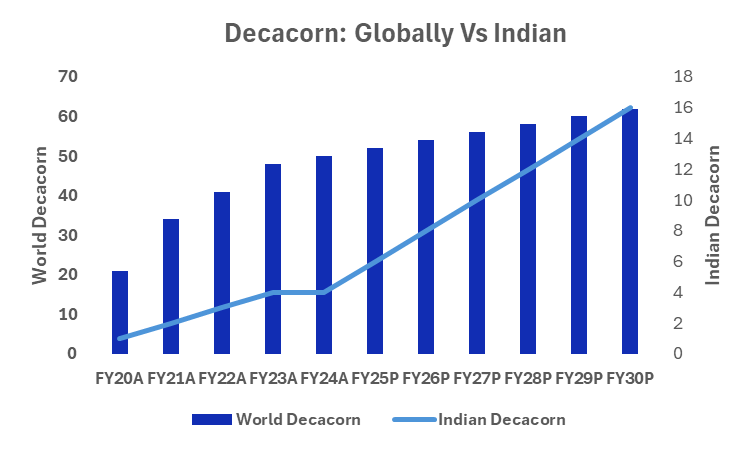
Do you know how many decacorns Indians have? Which is the first decacorn? “Flipkart” was the first Indian Decacorn to achieve the milestone in 2014 when it was acquired by Walmart. Then we have Phonepe as the second decacorn in 2025. Looking globally, SpaceX and ByteDance are part of an exclusive club.
Decacorns signify not just scaling a business, but also leading individual markets. They continue to rapidly build into different verticals, launch international operations, and attract interest from the largest-scale investment firms and the wealthiest investors. For venture funds, decacorns represent a partial or full exit through IPOs, share buybacks, and/or mergers, all providing returns so significant that they validate the high-risk part of the overall portfolio..
Based on the unicorn from 2020 to 2025, we got fewer decacorns as the journey from $ 1Bn to $ 10Bn is not an easy one. We have 4 decacorns, namely (Flipkart, Phone Pe, Razorpay, Zerodha), in comparison to 48 decacorns globally, and by the end of FY25, it is forecasted that there will be an addition of 2 to 4 new decacorn
s
Powered by Froala Editor
The structural transformation in India’s venture funding has come from the rise of Alternative Investment Funds (AIFs). These are privately pooled investment vehicles regulated by SEBI under the regulations 2012, created to invest in assets beyond traditional stocks, bonds, or mutual funds. AIFs target sophisticated investors—HNIs, family offices, and institutions—who seek exposure to higher-risk, higher-reward opportunities.
They are classified into three categories:
Category I: These CAT 1 Funds invest in startups, SMEs, infrastructure, and socially beneficial ventures.
Category II: These CAT 2 Private equity funds, venture capital funds, real estate funds, and debt funds that do not employ high leverage.
Category III: These CAT 3 include Hedge funds, derivatives and leverage in addition to CAT 1 and CAT 2 funds.
These AIFs help to diversify the portfolio, improving the start-up governance and supporting mentorship and expertise for founders. AIFs are expected to grow even faster than traditional mutual funds.
Powered by Froala Editor
The multi-bagger potential shown by major IPO like Nykaa, Urban Company.
Diversification through AIFs offers exposure both inside and outside the startup world, including real estate and infrastructure.
Domestic wealth from family offices and rich individuals is fueling India’s economic growth.
The government's push for Startup India, 100% FDI, and pro-startup policies keeps fueling momentum.
India's growth story to digitization, demographic dividend, and infrastructure spending creates an attractive long-term picture.
Conclusion
The story of VC Investment India has moved well beyond its experimental stage. From backing unicorns to nurturing decacorns, and now integrating AIFs with venture capitalists and family offices, they are primarily evolving with a deeper sector focus, much beyond fintech and e-commerce, making an ecosystem to enter a new phase of maturity. The AIF framework not only supports but actively accelerates the rise of venture funds, giving them scalability along with regulatory access and domestic capital access, too. With a rise in investor participation, supportive policies, and expanding opportunities across sectors, India’s venture funds are well-positioned to fuel the next generation of unicorns, decacorns, and beyond.
Powered by Froala Editor
Stay Connected, Stay Informed –
Don’t miss out on exclusive updates, market trends, and real-time investment opportunities. Be the first to know about the latest unlisted stocks, IPO announcements, and curated Fact Sheets, delivered straight to your WhatsApp.


Planify Enterprises Private Limited
Planify Capital Limited
Licensed By




Mutual Fund License No.:
ARN-164419
IRDA Code (1):
ABLIC1003123454
IRDA Code (2):
ABLIC1003131639
Startup India Certificate No.:
DIPP93786
Other Websites


ⓒ 2016-2026 Planify. All rights reserved, Built with
in India


