P/E vs P/B Ratio: Which Matters More for Unlisted Shares?
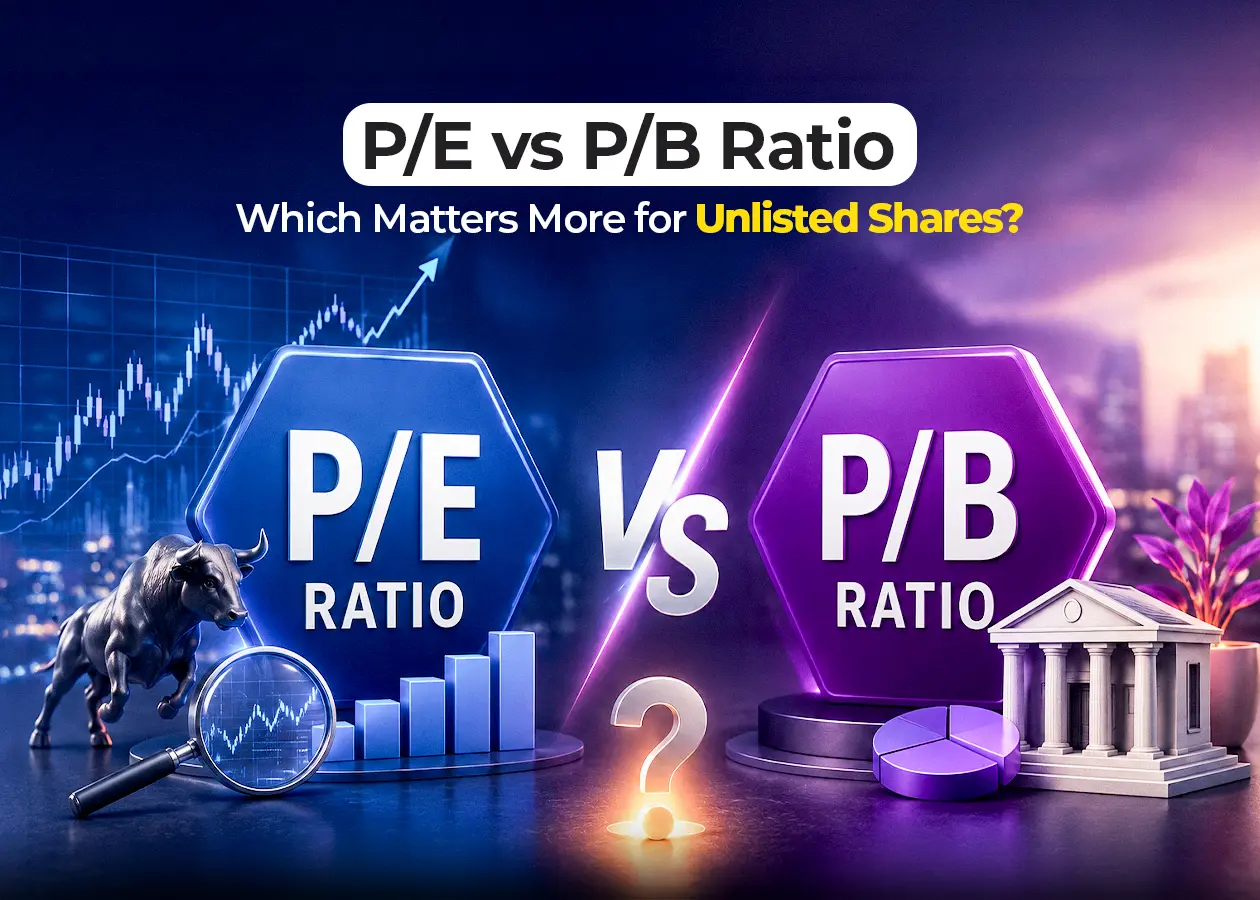


If you've spent any time evaluating unlisted or pre-IPO companies, you've probably run into this debate more than once. Two investors look at the same company — say, an NBFC gearing up for its IPO — and one swears by the P/E ratio while the other won't touch a stock without checking the P/B first. Both have a point. The trouble is, most articles treat this like a listed-market question and just port the answer over to unlisted shares without asking whether the underlying assumptions still hold. They mostly don't.
So let's actually work through this properly — what each ratio tells you, where it breaks down specifically in the unlisted space, and how to think about weighting one over the other depending on what you're looking at.
A Quick Refresher, Because Context Matters Here
The Price-to-Earnings ratio is just the price you're paying divided by the company's earnings per share. It answers a fairly intuitive question: how many years of current profit would it take to "pay back" your investment, roughly speaking. A P/E of 20 means you're paying 20 times what the company earns per share every year.
Price-to-Book, on the other hand, compares the price to the company's net worth on paper — assets minus liabilities, divided across shares. It's less about how much the company is earning and more about what it would theoretically be left with if it shut down tomorrow and sold everything off.
In listed markets, both numbers are easy to source and reasonably reliable because share prices update every second and audited financials come out quarterly. Unlisted shares don't get either luxury, and that changes the calculus more than people realize.
Where P/E Starts to Wobble in the Unlisted World
The biggest issue with leaning on P/E for pre-IPO companies is that earnings themselves are often unstable or, frankly, not the point yet. A lot of companies raising money in the unlisted space are prioritizing market share over profitability — think drone-tech firms, D2C brands, or infrastructure players still ramping up execution. Their earnings in any given year might be near zero, negative, or skewed by one-off items like a government subsidy or an asset sale. Divide a price by a number that's bouncing around like that, and the ratio you get isn't telling you much.
There's also a liquidity problem baked into the price side of P/E. Listed stock prices reflect thousands of trades happening continuously, which keeps the "P" reasonably honest. Unlisted share prices come from a much thinner set of transactions — sometimes just a handful of deals a quarter — so the price itself can lag reality or overreact to a single large trade. When both the numerator and the denominator are shaky, the resulting ratio inherits both problems.
That said, P/E still earns its keep once a company has a track record. If you're looking at a business that's already profitable, growing predictably, and has multiple funding rounds behind it — something like a well-established NBFC or a mature manufacturing player — P/E becomes genuinely useful for comparing it against listed peers in the same sector. It's a decent shorthand for "am I overpaying relative to what this business actually earns."
Where P/B Tends to do More of the Heavy Lifting
P/B earns its relevance in exactly the situations where P/E falls apart. For asset-heavy businesses — infrastructure companies, real estate players, NBFCs, anything with a balance sheet full of tangible value — book value is a sturdier anchor than earnings, which can be lumpy or manipulated through accounting choices far more easily than a balance sheet can be.
It's also more forgiving for early-stage or currently loss-making companies. A drone-tech startup posting losses this year isn't necessarily overvalued; if it's sitting on a strong asset base, meaningful IP, or contracts that haven't hit the P&L yet, P/B at least gives you a floor to reason from. P/E simply can't do that when the "E" is negative.
For financial institutions specifically — banks, NBFCs, insurance companies — P/B is often the industry-preferred metric anyway, listed or not, because their core business is essentially managing a balance sheet. Earnings can swing with provisioning cycles and credit costs, but the book value tends to move more predictably.
The catch with P/B in the unlisted context is that "book value" assumes the balance sheet is accurately marked. For younger companies, a chunk of what actually makes them valuable — brand, technology, customer relationships, a strong founding team — never shows up on the balance sheet at all. A capital-light consumer brand with massive growth potential can look expensive on P/B despite being genuinely undervalued, simply because its real assets are intangible and accounting doesn't capture them well.
So Which One Actually Matters More?
Honestly, it depends on what kind of company you're looking at — and that's not a cop-out answer, it's the actual answer.
For asset-heavy, mature, or financial-sector companies, weight P/B more heavily. It's the sturdier number and less prone to distortion from short-term earnings volatility.
For growth-stage, asset-light, or tech-driven companies, P/E — when earnings exist at all — combined with growth-adjusted metrics like PEG or revenue multiples usually paints a more honest picture than P/B, which will just make these companies look artificially expensive.
For companies somewhere in between — most manufacturing and consumer businesses fall here — the smart move is to look at both together rather than picking a favorite. A company trading at a low P/E but a sky-high P/B might be earning well temporarily off assets that don't justify the premium. A low P/E and a high P/B means that a company makes good money at the moment, but its assets don't support the high valuation. A low P/B and a high P/E means that this company is a promising business, but at the moment it doesn't show good financial results.
The Bigger Point that Often Gets Missed
Both of these measures weren't actually designed for private placement shares. They require pricing efficiency and comparable financial information, which aren't typical for the pre-IPO market. Instead of using ratios as a tool to draw conclusions, a better approach would be to use them as a basis for asking questions. When there is an unusually low P/E ratio for some company, then there could be an issue with the earnings of this company. In case when the P/B ratio seems high, this company can have valuable intangibles that can't be accounted in balance sheet or its price can be just high because of inefficient pricing.
Instead of treating them as final answers, use both ratios to explore a company in more detail. This makes them far more useful for unlisted investing than relying on either one alone.
Tags
Stay Connected, Stay Informed –
Don’t miss out on exclusive updates, market trends, and real-time investment opportunities. Be the first to know about the latest unlisted stocks, IPO announcements, and curated Fact Sheets, delivered straight to your WhatsApp.


Planify Enterprises Private Limited
Planify Capital Limited
Licensed By




Registrations & Certifications
Mutual Fund License No.:
ARN-164419
IRDA Code (1):
ABLIC1003123454
IRDA Code (2):
ABLIC1003131639
Startup India Certificate No.:
DIPP93786
Other Websites
Address
MiQB, Plot 23, Sector 18 Maruti, Industrial Development Area, near Motherson Sumi Systems Limited, Gurugram, Haryana 122015


ⓒ 2016-2026 Planify. All rights reserved, Built with
in India


