Risks of Investing in Unlisted Shares: What Nobody Tells You


Kratika Agrawal
Associate Financial AnalystFinancial Analyst at Planify with CFA L2 credentials, focused on valuation modeling and identifying growth opportunities across unlisted and pre-IPO equities.
Category
Unlisted stocks - stocks of firms that aren't listed on any official stock exchange such as NSE or BSE - have become a new fancy among investors in the past few years. Pre-IPO placement, equity from startups, ESOPs from private firms, and shares of firms such as defence PSUs prior to listing, or well-known private firms, are being sold aggressively through stockbrokers and WhatsApp groups. The theme always remains the same: come early, buy them cheap, and make a fortune when the company finally goes for listing.
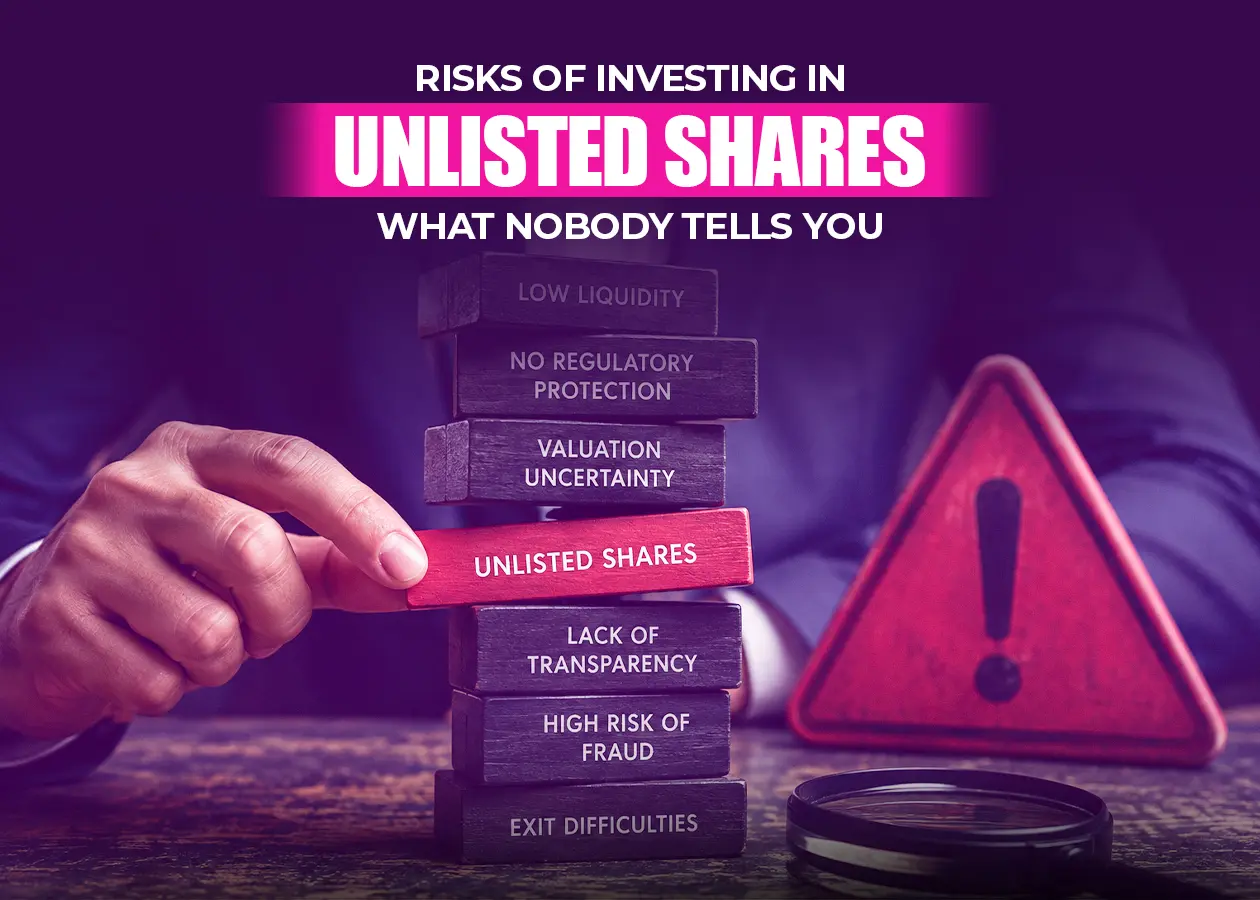
However, the flip side of the coin hardly gets any coverage. Investing in unlisted shares has certain risks which are not associated - or are associated to a much lesser degree - with investing in listed stocks.
Liquidity Risk: You May Not Be Able to Sell When You Want
This is the biggest risk, and it's a structural one, not a random one. There is no exchange, no order book, and no certainty of buyer for unlisted shares. The sale is dependent on finding a willing buyer – often via the same non-exchange broker network that sold them to you – who is prepared to pay what he or she wants, not what you want.
In tough times, buyers might disappear. You might find yourself with shares which you can't turn
into cash for many months or years, despite whatever merits the underlying business has.
Private companies sometimes have Right of First Refusal (ROFR) or transfer restrictions on their Articles of Association, whereby the company or other shareholders have the right to veto your sale to a third party or prevent you from selling the shares at all.
Listed shares are tradable within a few seconds whenever the market is open. Unlisted shares never are.
Price Discovery Is Opaque and Easily Manipulated
In an exchange, there is complete transparency in the pricing of stocks through thousands of traders. In the over-the-counter market:
- Quotes for prices can come from just a few middlemen and dealers, and these are based on recent transactions that cannot be verified.
- The same percentage can be priced at significantly different levels by different dealers at the same time.
- There are no regulations stipulating that these quotes should indicate any form of fair value; they can be manipulated to create a sense of panic ("the price is going up, make your move") or create a sense of fear in existing holders ("the price is falling, sell now").
- Since the market is very small, a few transactions can manipulate the "market price," and the manipulation can attract new buyers.
In essence, you are believing the seller in what value that share has.
Limited and Unverified Financial Information
Listed firms are required by law to disclose quarterly performance, annual reports, related party dealings, and important events to stock exchanges. Non-listed companies do not have any such requirement towards retail investors.
- You usually depend upon unofficial shareholder presentations, dealer presentations, or old financials which may even be one year old.
- It is not mandatory for the company to keep its unlisted shareholders informed of their poor performance, changes in management, lawsuits, or regulatory actions.
- The audited financials, whenever available, may not always be up to date, while the forecast of an IPO/valuation is always dealer optimism.
No Guarantee of Listing - or Listing on Your Timeline
The rationale for buying unlisted shares is largely predicated upon its eventual IPO. However:
- Firms have the ability to delay their IPOs indefinitely because of various reasons.
- Firms choose not to go for an IPO and continue to trade informally; thus leaving investors holding illiquid shares without a set exit route.
- If there is any IPO after that, you might find that the IPO is priced lower than the price at which you bought the shares in the unlisted market; this is evident from the Indian market scenario where many firms which went on for IPO saw their share prices fall below that in the unlisted market.
- Even regulations (such as the recent ones imposed by SEBI regarding pre-IPO share trades) play an important role in the transactions of such shares.
No contractual provision compels a business to be listed on any deadline.
Valuation Risk and the "FOMO Premium"
The scarcity and exclusivity of unlisted shares lead many purchasers to pay more, not because of fundamentals but due to hype.
- “Last funding round valuation” is the benchmark usually used by dealers, but the valuation done during a private funding round with one institution who negotiates terms on its own cannot be taken as the market price for a small retail parcel.
- By the time retail investors receive the stock after several intermediations in between, each of them will take a cut.
- There is nowhere to bottom out if the growth story of the business does not materialize. No circuit filters, no market makers, nothing.
Regulatory and Legal Grey Areas
In India, trading in unlisted stocks takes place under much less stringent regulation than that of listed stocks.
- The trades usually take place off-market and through bilateral physical/demat transfer through intermediaries who need not always be SEBI-registered stock brokers in this respect.
- The disputes of delivery, delay in share transfers or frauds of share certificates are much less addressed than those in exchange-traded trades where they get support from clearing firms.
- The fraud is a genuine and recurring matter where fraud of fake share certificate, selling of the shares that seller does not own or companies that do not exist have all been observed in this case.
- The KYC and the transfer process may be a time taking and manual process (physical delivery instructions and signature verification through company registrars).
Dilution Risk
Private firms and start-ups often raise additional money through financing rounds.
- Each new funding round can water down their ownership stake unless anti-dilution provisions are explicitly negotiated, which is rare for retail unlisted stockholders.
- In addition, you could structurally be subordinate to institutional investors that hold preference shares, which means they are paid out first in case of liquidation or acquisition.
- Unlisted retail stockholders normally only hold simple equity without any special provisions.
Other risk
- Besides the concerns mentioned above, there are a couple more worth mentioning. For starters, unlisted shares require an investor to make a sizeable investment into a single non-liquid and unverifiable position due to the large minimum lot requirement for the deals and because unlisted share purchases do not usually take place via diversified vehicles but as standalone “investment opportunities”, which result in high exposure to only one or two private companies – something easily avoided in the listed markets via mutual funds or ETFs and by purchasing smaller lots in several different stocks.
- Additionally, tax treatment of such investments is less attractive and much more complicated: holding period less than 24 months results in short-term capital gains being taxed at your income slab rate and although long-term capital gains (over 24 months) do not face such an unfavorable tax treatment, their structure is more complicated and doesn’t have the simplicity of Section 112A for listed shares since transactions aren’t on market and, therefore, it is up to an investor to provide correct information regarding cost of acquisition, period of holding and mode of transfer for taxation purposes and if a company later goes public, post-IPO sale gets complicated from a tax perspective.
What This Doesn't Mean
All of the above does not necessarily imply that unlisted securities cannot be a good investment. There are plenty of legitimate examples, and there have been some early investors in major corporations who made millions. What is important to understand is the nature of the risk involved, which differs structurally and is usually understated in comparison with the possible reward.
Questions Worth Asking Before You Invest
- Who precisely am I purchasing from, and is this a traceable entity?
- Is the valuation offered based on an actual recent deal, or is it just a claim made by a dealer?
- What is the recent audited financial data that I can access, and how recent is it?
- Does this firm have any schedule for going public, and if this goes on for years, what happens to my money?
- Are there any conditions preventing me from selling the shares even if I manage to find someone to purchase them?
- What is the worst-case scenario when it comes to this firm failing to go public or get acquired?
- Have I positioned myself in such a way that losing this money will not affect my financial well-being in any material way?
Bottom Line
Unlisted stocks exchange the clarity, liquidity, and protections of listed exchanges for the prospect of outsized returns in the very early stages. It is reasonable enough for such a trade-off to be made in a very small position by someone who knows what he or she is losing. Such an investment strategy becomes much more questionable in the case of a significant investment made based on a pitch from the salesperson and FOMO (fear of missing out). This lack of pricing and exits should define the asset class itself.
Tags
Stay Connected, Stay Informed –
Don’t miss out on exclusive updates, market trends, and real-time investment opportunities. Be the first to know about the latest unlisted stocks, IPO announcements, and curated Fact Sheets, delivered straight to your WhatsApp.


Planify Enterprises Private Limited
Planify Capital Limited
Licensed By




Registrations & Certifications
Mutual Fund License No.:
ARN-164419
IRDA Code (1):
ABLIC1003123454
IRDA Code (2):
ABLIC1003131639
Startup India Certificate No.:
DIPP93786
Other Websites
Address
MiQB, Plot 23, Sector 18 Maruti, Industrial Development Area, near Motherson Sumi Systems Limited, Gurugram, Haryana 122015


ⓒ 2016-2026 Planify. All rights reserved, Built with
in India


