Top 10 Unlisted Shares to Buy in 2026



The Indian stock market tells only half the story. While everyone debates Nifty targets and FII flows, a parallel market has been building in unlisted shares: equity in companies not yet listed on NSE or BSE. The concept is not new; the scale is. Hundreds of companies now trade over the counter, research is more widely available to retail investors, and a busy IPO pipeline has made exits more visible.
But unlisted investing is not for the impatient. Liquidity is thin, disclosures are limited, and the gap between unlisted prices and eventual IPO pricing can be large, as HDB Financial shareholders learned in 2025. With that in mind, here are 10 companies we picked for 2026 based on business quality, closeness to IPO and the risks involved.
Which unlisted shares did we pick for 2026?
Our 2026 picks are NSE, Zepto, Reliance Retail, Hero FinCorp, SBI Funds Management, Hella Infra Market, Orbis Financial, Chennai Super Kings, NCDEX and Goodluck Defence, chosen for business fundamentals, IPO visibility and risk.
Scorecard: price and market cap today
No. | Share name | Indicative price | Market cap |
|---|---|---|---|
1 | NSE (Listed) | ₹1,761.00 | ₹4,35,847.50 Cr |
2 | Zepto | ₹29.66 | ₹37,381.08 Cr |
3 | Reliance Retail | ₹1,245 | ₹11,18,878.27 Cr |
4 | Hero FinCorp | ₹952.00 | ₹12,129.69 Cr |
5 | SBI Funds Management (Listed) | ₹544 | ₹1,10,915 Cr |
6 | Hella Infra Market (CCPS) | ₹82,495 | ₹9,415.63 Cr |
7 | Orbis Financial | ₹332 | ₹4,052.40 Cr |
8 | Chennai Super Kings | ₹236 | ₹8,962.02 Cr |
9 | NCDEX | ₹278 | ₹1,409.81 Cr |
10 | Goodluck Defence | ₹433 | ₹2,126.46 Cr |
1. NSE: National Stock Exchange of India
NSE is the most widely tracked name in the Indian unlisted market and for good reason. As India's largest stock exchange with a near monopoly in equity derivatives, every new demat account, every SIP, and every F&O trader adds directly to NSE's revenue. The implied market cap in the unlisted market stands at over ₹5 lakh crore, and the long-awaited DRHP filing is expected in the second week of June 2026.
HNIs who entered NSE unlisted 7–8 years ago have seen 10x returns. The grey market price currently trades around ₹1,975–1,995, off its 52-week high of ₹2,470, offering a better entry point than six months ago. The trailing PE at ~46x is not cheap, so IPO pricing will be the critical test. Buy on corrections; the underlying business is irreplaceable.
Investors to watch: HNIs, family office, institutional funds. Key Risk: IPO regulatory timeline has moved several times. Further delays will pressure the unlisted price.
2. Zepto
Zepto has done what many skeptics said was impossible: it has built a profitable unit economics model in the Indian quick commerce market. SEBI has approved its IPO, Zepto has filed an updated DRHP targeting a ₹8,010 crore fresh issue plus OFS, and the listing is expected in H2 FY27. At a $7 billion valuation, Blinkit and Swiggy Instamart provide directly comparable listed benchmarks.
The unlisted price has corrected from higher levels to the ₹40–49 range post DRHP filing, creating a window for investors with a short pre-IPO horizon. This is a trading opportunity around a clear catalyst, not a decade-long compounding story. Entry price discipline matters more here than with any other name on this list.
Investors tracking: Tiger Global-backed; strong HNI interest post-SEBI approval. Key risk: IPO pricing relative to Blinkit and Swiggy Instamart comps; market conditions at listing.
3. Reliance Retail
Reliance Retail is India’s largest unlisted company by revenue at ₹2,71,227 crore in FY25. It has 19,000+ stores in 7,000+ cities, brands such as JioMart, AJIO, Reliance Digital and Hamleys, and is bringing the kirana network of India into its digital supply chain. When Reliance Industries eventually lists this entity separately, it will be among the biggest IPOs in India’s history.
The challenge is timeline unpredictability. Reliance Retail's IPO has been "expected" for several years and still has no confirmed date. Unlisted shareholders can be locked in far longer than anticipated. The upside is access to India's dominant retail franchise at scale. Enter only if you can stomach an open-ended holding period and have no need for near-term liquidity.
Investors tracking: Sovereign wealth funds, large family offices, long-horizon HNIs. Key risk: IPO timing is entirely dependent on Reliance Industries' strategic calendar, with no external visibility.
4. Hero Fincorp
Hero FinCorp began as a captive two-wheeler financier and has grown into a full-spectrum NBFC offering consumer loans, MSME credit, corporate finance, and housing loans. Provisioning has declined significantly while income streams have diversified, a combination that signals genuine asset quality improvement, not window dressing. The IFC's commitment to invest $100 million in secured debt is external validation that carries real weight.
The 52-week correction from ₹2,200 to the current ₹1,044–1,075 range has brought valuations much closer to a defensible zone. Investors averaging in at current levels are building a position in a fundamentally improving NBFC backed by one of India's most respected industrial groups. This is an 18–24 month thesis, not a quick trade.
Investors tracking: IFC, institutional NBFCs, and HNI investors with an NBFC sector view. Key risk: Asset quality in the two-wheeler segment remains sensitive to rural income cycles and rate movements.
5. SBI Funds Management
SBI Mutual Fund manages more AUM than any other fund house in India, and the IPO, a ₹13,000 crore offering, is reportedly scheduled between June and July 2026, with investment banking mandates already awarded. The SBI distribution network (22,000+ branches) is a structural moat that no private AMC can replicate. AUM here grows partly on autopilot through SBI's retail banking footprint.
HDFC AMC and Nippon India AMC provide listed comps to benchmark valuation. If SBI MF prices attractively relative to peers, the unlisted entity at ~₹768–775 should yield meaningful listing-day gains. This is primarily a pre-IPO trade. Clarity of exit is actually the strongest feature of this opportunity right now.
Investors tracking: HNIs, family offices seeking near-term IPO exit, AMC sector funds. Key risk: Overpriced IPO relative to listed AMC peers would compress returns significantly.
6. HellaInfra. Market
Hella Infra. Marketis India's largest B2B construction materials platform think cement, steel, pipes, waterproofing, everything that goes into building the country and it has gone from a marketplace to a manufacturing force. FY26 revenue grew 7% YoY to ₹20,000 crore, with profit at ₹300–325 crore. SEBI cleared its IPO plans in January 2026, and a ₹5,000 crore listing is expected in the next 4–6 months. The final pre-IPO round of ₹500 crore at ₹25,000 crore valuation is already partially closed, with Tiger Global, Accel, and Nexus participating.
When Nikhil Kamath's family office and institutional investors of that calibre write pre-IPO cheques, it signals conviction that the listing window is real. This is India's infrastructure boom packaged into a private company on the verge of going public.
Investor(s) Tiger Global Accel Nexus Ventures Nikhil Kamath family office Ashish Kacholia Key risk: Revenue growth has slowed down. Long working capital cycles in construction can create cash flow pressures.
7. Orbis Financial Services
Orbis Financial is a custody and fund services company for institutional capital markets clients; it processes settlements, manages fund administration, and provides capital market infrastructure to the asset management industry. It has grown at ~30% revenue CAGR while attracting zero hype. The valuation remains reasonable precisely because there is no IPO catalyst creating an urgency premium.
If you are building an unlisted portfolio where not every position needs a 12-month exit, Orbis earns its place as the durable, low-drama compounder. Orbis is at the heart of India's fast-growing asset management industry. Investors in this space who have bought and held for three or more years have been consistently rewarded.
Investors to keep an eye on include capital markets, family offices, CDSL/NSDL ecosystem investors, and long-term HNIs. The main risk is that there will be no IPO catalyst in the near future; the exit will be via a secondary OTC sale or a subsequent listing, which could take years.
8. Chennai Super Kings (CSK)
CSK is the only sports franchise that is actively traded in the Indian unlisted market. Revenues are generated from IPL central media rights (which have grown exponentially over rights cycles), title sponsorships, gate receipts and merchandise. Fan loyalty creates pricing power that most consumer brands would envy. The franchise model means there is no traditional earnings call, no quarterly guidance, and no promoter dilution dynamic.
This is not an investment you analyze on PE multiples. It is a culturally anchored alternative asset you are buying into IPL economics and media rights inflation. The grey market price of ₹254-266 indicates that the stock is consolidating after a strong run earlier this year. View the position as a thematic bet and not a core portfolio holding.
Investors tracking: Investors with appetite for sports/entertainment, believers in IPL media rights, alternative asset investors. Key risk: No IPO has been announced or even discussed publicly. This is effectively a closed-ended bet on franchise value appreciation.
9. NCDEX
NCDEX is India's primary agricultural derivatives exchange, and its business model is one of the most structurally durable in financial services: low capital intensity, high operating leverage, and network effects that no new entrant can replicate quickly. India's commodity markets are at an early stage of formalization; the growth runway stretches well beyond 2026.
The current grey market price of ₹368–388 has corrected from higher levels, partly reflecting uncertainty about IPO timing. But the business has not changed. India's agricultural modernization, commodity formalization, and the push for price discovery at the farmer level all strengthen NCDEX's long-term relevance. For investors in the patient camp, this dip should be taken constructively.
Investors to watch: Exchange infrastructure specialists, long-horizon capital markets investors, agri-sector family offices Key risk: uncertain IPO timeline, less-liquid OTC market than top-tier unlisted names.
10. Goodluck Defence
Defence manufacturing is India's strongest structural investment theme of this decade. Goodluck Defence operates at the intersection of government procurement, import substitution, and long-cycle order visibility with exposure to high-value programmes including BrahMos. The headline metric that stands out is zero debt in a capital-intensive manufacturing sector. That is not a coincidence; it is evidence of business quality.
At ₹375–390 in the grey market, the valuation is not cheap defence unlisted stocks never are. But long-cycle government orders provide multi-year revenue visibility that most sectors can only wish for. This is a 24–36 month thematic hold, not a quick listing trade. Position sizing should reflect the illiquidity and the wait.
Investors tracking: Defence sector HNIs, thematic pre-IPO investors, and capital market professionals tracking PLI beneficiaries. Key risk: High PE in the grey market; any delay in order execution or government procurement shifts will pressure the unlisted price.
What the HDB Financial Lesson Taught Every Unlisted Investor
When HDB Financial set its IPO price band in June 2025, the upper end of ₹740 was about 42% below the ₹1,275 its shares traded at in the unlisted market earlier that month. In 2026, two of our own picks repeated the pattern. Unlisted prices are expectations, not guarantees.
Company | Unlisted reference | IPO price | Listing price | IPO vs unlisted |
|---|---|---|---|---|
HDB Financial (Jul 2025) | ₹1,275 | ₹740 | ₹835 | −42.0% |
SBI Funds Management (Jul 2026) | ~₹770 | ₹574 | ₹613.30 | −25.5% |
NSE (Sep 2026) | ~₹1,985 | ₹1,785 | ₹1,800 | −10.1% |
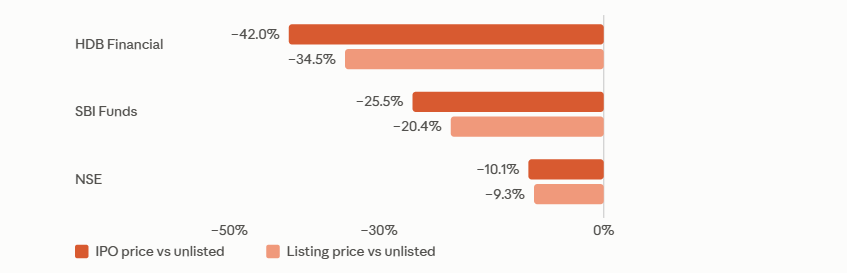
Unlisted references are indicative. SBI Funds and NSE references are midpoints of the ranges quoted in this article's original version.
Before entering any name on this list, be clear on three things:
- Are you making an IPO-timing bet or a business bet? The answer changes your holding period completely.
- What is your exit if there is no IPO for three years? Every unlisted position needs an answer.
- Is the unlisted valuation reasonable against listed peers? If not, you need a very strong reason to pay the premium.
Conclusion
The unlisted market in 2026 rewards investors who do their homework and punishes those who chase grey market buzz. Every name on this list has a real business behind it, but real businesses still get mispriced, IPOs still disappoint, and liquidity still dries up when you need it most. The edge in this market has never been about picking the right company. It has always been about entering at the right price, knowing exactly why you are there, and having the patience to let the thesis play out. If you get those three right, the unlisted market will work for you. Get them wrong and even the best company on this list will feel like a mistake.
Tags
Stay Connected, Stay Informed –
Don’t miss out on exclusive updates, market trends, and real-time investment opportunities. Be the first to know about the latest unlisted stocks, IPO announcements, and curated Fact Sheets, delivered straight to your WhatsApp.


Planify Enterprises Private Limited
Planify Capital Limited
Licensed By




Registrations & Certifications
Mutual Fund License No.:
ARN-164419
IRDA Code (1):
ABLIC1003123454
IRDA Code (2):
ABLIC1003131639
Startup India Certificate No.:
DIPP93786
Other Websites
Address
MiQB, Plot 23, Sector 18 Maruti, Industrial Development Area, near Motherson Sumi Systems Limited, Gurugram, Haryana 122015


ⓒ 2016-2026 Planify. All rights reserved, Built with
in India


