

Power Exchange India Limited (PXIL): FY26 Financial Review and Business Model Breakdown
02 July 2026
Power Exchange India Limited (PXIL), India's second operational power electronic marketplace regulated by the CERC, is gaining significant attention in the unlisted market with an implied valuation of about ₹3,100 crore. Promoted by major players like NSE Investments, NCDEX, and Power Finance Corporation, the company runs a digital transaction platform where electricity and energy certificates are traded. This marketplace helps distribution companies (DISCOMs), large industrial units, independent power producers, and open-access consumers manage risk, improve short-term energy procurement, and achieve price discovery transparently and in real time.
PXIL’s operations center around a business model that relies on volume-based transaction fees. Unlike stock exchanges that charge based on trade value, PXIL imposes a flat transaction fee linked strictly to physical volume. This fee is typically set at ₹0.02 per kWh from both buyers and sellers for electricity and a fee of ₹10 per unit for Renewable Energy Certificates (RECs) and Energy Saving Certificates (ESCerts). PXIL diversifies its core transactional income with recurring revenue from new member registrations, annual subscription fees, software connectivity charges, and interest income from cash reserves. The exchange serves as a central counterparty that collects upfront margins and guarantees settlement, which eliminates counterparty credit risk. This structure provides significant operating leverage; once its digital platform infrastructure is established, incoming trading volumes contribute directly to profits with minimal additional costs.
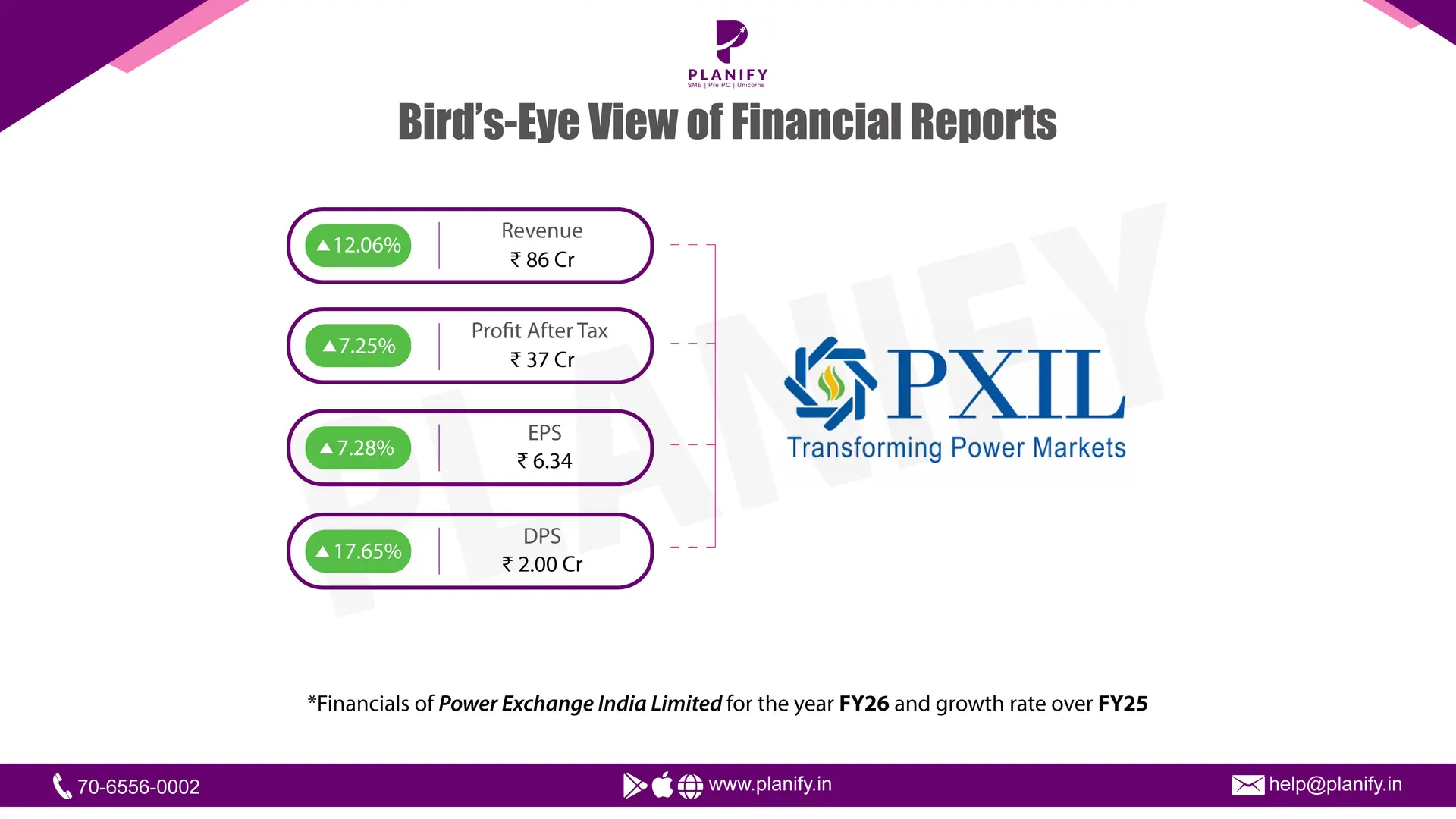
Financially, the company has had a steady, albeit modest, year. Revenue from operations grew by a solid 12.1%, reaching ₹86.4 Cr in FY26 compared to ₹77.1 Cr in FY25. However, total income growth was a bit softer at 8.1%, climbing to ₹100.4 Cr in FY26 from ₹92.9 Cr in FY25. This slowdown was due to a decline in interest income from the company’s large cash reserves, while other income fell by 11.4% to ₹14.1 Cr. On the expense side, rising employee costs and taxes limited overall earnings growth, keeping total expenses at ₹50.7 Cr. As a result, Profit After Tax (PAT) showed a modest rise of 7.2%, reaching ₹37.0 Cr in FY26, up from ₹34.5 Cr in the previous fiscal year. This increase pushed its Earnings Per Share (EPS) up by 7.3% to ₹6.34, allowing the company to raise its dividend per share from ₹1.70 to ₹2.00.
The primary investment opportunity enhancing this price tag is the upcoming implementation of market coupling under India's power sector reforms. This regulatory change aims to centralize price discovery into a single national pool across all platforms, effectively breaking down the near-monopoly of Indian Energy Exchange (IEX). While the ₹3,100 crore valuation suggests a high multiple compared to its current trailing earnings (trading at a P/E of roughly 80x to 90x based on the FY26 EPS of ₹6.34), its backing by institutions, debt-free balance sheet, strong cash reserves, and the significant structural tailwinds of growing power demand in India make it an attractive high-growth option for long-term pre-IPO investors willing to navigate the regulatory changes.

Stay Connected, Stay Informed –
Don’t miss out on exclusive updates, market trends, and real-time investment opportunities. Be the first to know about the latest unlisted stocks, IPO announcements, and curated Fact Sheets, delivered straight to your WhatsApp.


Pre Ipo

Upcoming IPO

Unicorn


Planify Enterprises Private Limited
Planify Capital Limited
Licensed By




Mutual Fund License No.:
ARN-164419
IRDA Code (1):
ABLIC1003123454
IRDA Code (2):
ABLIC1003131639
Startup India Certificate No.:
DIPP93786
Other Websites


ⓒ 2016-2026 Planify. All rights reserved, Built with
in India


